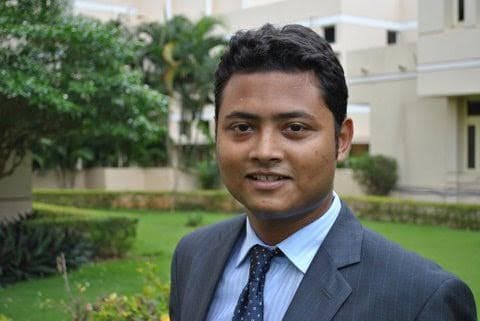
Dr. Swapnil Sahoo.
Swapnil Sahoo Learning Lab
A free 14-day guide for first-time student entrepreneurs: turn an idea into a small, affordable experiment with actual customers, practical guidance and feedback.
Start your venture experimentBefore joining academia, I spent 17 years in strategic roles at Wipro, Accenture, Cognizant, Exilant, TimesofMoney, Mahindra and 42Gears Mobility. That experience now shapes my research on how organisations act when resources are tight and the way I teach Strategy & Entrepreneurship at Great Lakes Institute of Management, Gurgaon, where I head the Entrepreneurship and AI initiatives. I earned my Ph.D. in Entrepreneurship from XLRI Jamshedpur, with a dissertation titled “Entrepreneurial Resourcefulness in Resource-Constrained Environments”.
The organisations that shaped my work
- Great Lakes Gurgaon
- XLRI Jamshedpur
- XIMB
- Wipro
- Accenture
- Cognizant
- Exilant Technologies
- TimesofMoney
- Mahindra
- 42Gears Mobility
Currently
Gurgaon, India
How to enter this website
Begin with the questions that connect the work.
Does seventeen years across seven employers prove resourcefulness, or just make it plausible?
If a classroom exercise looks impressive, how would you know it actually changed judgment?
Years of experience
Conference presentations
Lives reached / yr (Karma Yoga)
Karmabhoomis (field sites)
Active research streams
01 / About
From industry practice to the strategy classroom.
I came to academia after 17 years in industry, with strategic roles at Wipro, Accenture, Cognizant, Exilant Technologies, TimesofMoney and Mahindra. Most recently, as Global Partnership Head at 42Gears Mobility, I worked with senior leaders across Europe, the Middle East and Africa.
That route still shapes how I work. In the classroom, ideas have to survive contact with decisions, people and constraints. In research, I keep returning to a practical question I encountered in industry: what do organisations do when the resources they need are not available?
I am now an Assistant Professor of Strategy at Great Lakes Institute of Management, Gurgaon, where I teach Strategy and Entrepreneurship and head the Entrepreneurship and AI initiatives. My work also includes academic programme design, social-impact initiatives and institutional strategy. Great Lakes is accredited by AACSB and AMBA.
I earned my Ph.D. in Entrepreneurship from XLRI Jamshedpur. My dissertation, “Entrepreneurial Resourcefulness in Resource-Constrained Environments,” continues to ground my research on frugal innovation, jugaad, bricolage, effectuation, family firms and neurodiverse teams.
Education
- Ph.D. in Entrepreneurship · XLRI Jamshedpur
- MBA (Finance & Marketing) · XIMB
- B.Tech (Electronics & Telecom) · Utkal University (ITER)
Questions I return to
- What do organisations do when the resources they need are not available?
- Why do some organisations keep turning constraint into useful action?
- How do governance, trust and succession shape innovation in family enterprises?
- When does AI genuinely help learning, and where is human judgment still essential?
Languages
English · Hindi · Odia · Bengali · French · Spanish
Beyond the classroom
- Distinguished Toastmaster (DTM) · Toastmasters International, 2012
- Volunteer, The Art of Living Foundation
- Blood donor volunteer, Indian Red Cross Society
02 / What colleagues say
Seventeen years, in their words.
Recommendations from teammates, clients and managers across Accenture, Cognizant, Mahindra Comviva, TimesofMoney and 42Gears Mobility—the industry years the research and teaching now draw on.
03 / Research agenda
Creating strategic possibility under constraint.
Four connected branches grow from my submitted doctoral thesis: neurodiverse entrepreneurial agency, bricolage and effectuation, family-business resourcefulness, and frugal innovation through dynamic capabilities.
Doctoral foundation · XLRI Jamshedpur
Entrepreneurial Resourcefulness in Resource-Constrained Environments
The thesis brings together three connected perspectives: neurodiverse entrepreneurial agency, the movement from bricolage to effectuation, and family-business resourcefulness in institutional voids. It provides the foundation for a broader agenda on inclusive entrepreneurship, family-enterprise innovation, frugal problem-solving and dynamic capabilities.
Read the doctoral foundationNeurodiversity & Entrepreneurial Agency
- Central question
- How do neurodiverse traits translate into entrepreneurial agency and resourcefulness in environments characterised by limited resources?
- Context
- Neurodiverse founders, entrepreneurial teams, incubators and support environments where individual variability matters more than broad diagnostic stereotypes.
- Thesis connection
- The first thesis essay develops the ‘spiky profile’ as a conceptual lens and connects it with coping, sociomateriality and affordances across the entrepreneurial lifecycle.
From Bricolage to Effectuation
- Central question
- Under what conditions can bricolage become a springboard to effectuation as legitimacy and access to resources improve?
- Context
- Family enterprises and small firms operating under material scarcity, legitimacy deficits and uneven access to formal markets or institutions.
- Thesis connection
- The second thesis essay studies family enterprises that begin by recombining locally available resources and examines whether effectual action becomes more prominent as their room to manoeuvre expands.
Family Business Resourcefulness
- Central question
- How does family-business resourcefulness manifest in institutional voids, and where are the boundaries of family-based coordination?
- Context
- Family firms in institutional voids, where formal contracting, specialised markets and reliable infrastructure may be incomplete or costly.
- Thesis connection
- The third thesis essay introduces Family Business Resourcefulness (FBR) as an emerging construct and distinguishes active resource mobilisation from socioemotional wealth.
Frugal Innovation & Dynamic Capabilities
- Central question
- How does family-business resourcefulness become frugal innovation through dynamic capabilities, and when does family-centred value strengthen or constrain that pathway?
- Context
- Family firms seeking useful, affordable solutions under resource constraint while balancing economic, social and family-centred goals.
- Thesis connection
- The thesis tests a model in which dynamic capabilities carry much of the relationship between Family Business Resourcefulness and frugal innovation, with socioemotional wealth considered as context.
04 / Selected publications
Research, cases and public questions.
My writing moves from research on organisations under constraint to teaching cases and public essays about decisions facing businesses, students and policy readers, plus the interviews national outlets have carried. The complete record — every article, case, essay and press mention — lives on the Press & Media page.
7
Research & chapters
3
Case studies
7
Essays
17
Press mentions
Entrepreneurship Under Constraint: How Bricolage Transitions into Effectuation in Family Businesses
with Munish Thakur · Academy of Management Proceedings
Millennium Post · Sep 2026
AI is changing jobs, skills become the differentiator
Most recent press mention
05 / Conferences & talks
Where I present the work.
Conferences are where unfinished ideas meet hard questions. This record includes the papers, doctoral work and collaborations I have taken into those conversations.
- AOM 2026Philadelphia, PA, USA · 4 Aug, 1:15–2:45 PM · Marriott Downtown, Franklin 8
Entrepreneurship Under Constraint: How Bricolage Transitions into Effectuation in Family Businesses
86th Annual Meeting of the Academy of Management
Also at AOM 2026: a research conversation with Prof. Saras Sarasvathy on the bricolage–effectuation work, and a session with the Saxbys and Drexel teams on their student-led café model.
BAM 2025Kent Business School, UK4 papers · Session Chair, Entrepreneurship TrackDrawn from the doctoral dissertation, "Entrepreneurial Resourcefulness in Resource-Constrained Environments." Also served as Session Chair for the Entrepreneurship Track (held online).
- ·Thriving with Less: Family Entrepreneurship in Institutional Voids
- ·Towards a Unified Theory of Entrepreneurship: A Neurodiverse Promise of the Spiky Profile
- ·Conceptualising Family Business Resourcefulness in Resource-Constrained Environments
- ·Resourcefulness of Family Business in Penurious Environments
- AOM 2026 · PDWPhiladelphia, PA, USA
AI and Algorithmic Governance in Inter-Firm Relationships
AOM Paper Development Workshop · roundtable led by Prof. Robert Seamans, NYU Stern
- AOM 2026 · PDWPhiladelphia, PA, USA
Entrepreneurship Research in Non-WEIRD Contexts
AOM Entrepreneurship Division's Global Scholar Development Committee · panel discussion and interactive paper development workshop
With panelists and discussants Dean Shepherd, Madeline Toubiana, Raj Krishnan Shankar, Banu Goktan Bilhan, Magdalena Markowska and Ipek Koparan. Session record: https://events.aom.org/events/aom-2026/session/UFVyz8CpQb3JGVqoouUNt
- AOM 2025Copenhagen, Denmark · Jul 25–29
Conceptualising Family Business Resourcefulness: A Socio-material Perspective on Family Firm Advantages in Resource-Constrained Environments
85th Annual Meeting of the Academy of Management
- XLRI · 2024
Cultivating Trust: Exploring the Nexus of Human Capital and Organizational Citizenship Behaviour in Family Enterprises
International Industrial Relations Conference · with Leeds University Business School & Friedrich Ebert Stiftung
- XLRI · 2024
Navigating the Maze: Understanding Corporate Bribery and Ethical Choices in Indian Family Firms
International Conference on "Enabling Social and Business Responsibility in Our Globalised World"
- XLRI · 2024
Conceptualizing Family Business Resourcefulness (FBR) in a Resource-Constrained Environment
Doctoral Colloquium on AI & Sustainability
- MERC 2023 · IIM Kashipur🏅 Best Paper in Track
A Study of How Family Involvement Impacts Sustainable Innovation in Family Firms
Entrepreneurship Track 1
- SBM 2023 · IIT Roorkee + ASU
An In-depth Analysis of the Impact of Family Involvement on Sustainable Innovation in Family Firms
- POMS India 2023 · XLRI
Exploring the Innovation Heritage: Decrypting the Influence of Family Involvement in Propelling R&D within Family Enterprises
- IIT Kharagpur · 9th MDC
Bibliometrics Analysis of Family Firms Internationalization
06 / Teaching
Teaching strategy through decisions, trade-offs and practice.
Across PGPM and PGDM classrooms, I use cases, simulations, fieldwork and build exercises to move from a framework to a defensible decision. AI appears where it genuinely improves the work; fluent output still needs verification and human judgment.
Programme
STRAMGT 221: Strategy and Disruption
Strategy sessions, cases and reading lists designed for an experienced PGPM cohort.
Open page
Programme
STRAMGT 206: Strategic Management
Strategy and entrepreneurship modules, session material and practice across the PGDM terms.
Open page
Experiential Leadership
Karma Yoga
Two pathways: a B-school field-learning architecture and longer community partnerships, beginning with the story of Mehalchauri.
Open page
Strategy Capstone
Business Simulation
Twenty connected sessions in which choices in strategy, finance, markets, operations, people and ESG affect one another.
Open page
Consulting
Cracking Consulting Interviews
My in-depth, first-person guide: the process end to end, the case method, framework families, the fit round, group discussions and the mistakes I see most often.
Open page
Student mentoring
Strategy Showdown
Faculty mentor for a student-run, four-stage business competition — a 15-question qualifying quiz narrowing the field to 8 teams, then a judged 90-second video round scored on content, creativity, teamwork and impact.
Winner: Cognify (66.7 pts) · Runners-up: Logistics Issue (66.6) and Alpha Strategists (60.5)
Student feedback
Strategic Management, PGDM · student feedback
4.48 / 5overall faculty rating
- “Good and engaging classes.”
- “Very interactive and engaging class.”
- “The way he is open to our opinions and viewpoints makes us feel very valuable.”
07 / PhD supervision
A practical guide to working together.
I supervise doctoral and pre-doctoral work in strategy, entrepreneurship and organisation theory. I take on only a few researchers in each cycle because close reading, candid feedback and regular conversation take time.
Your first note
Start with one page rather than a full proposal. Name the research puzzle, state the question clearly, explain why it matters now and tell me why my work is relevant to it.
What I look for
- · A research puzzle, not only a topic
- · Methodological seriousness
- · Reference integrity (no fabrications)
- · Patience for revision
Our working rhythm
- · Weekly written check-ins
- · Theory-first, then design
- · Co-author when warranted
- · Honest, constructive critique
Open topics
- · Family business resourcefulness
- · AI in management education
- · Frugal innovation in services
- · Neurodiversity & capabilities
Before you send it
- · Read two of my papers
- · Draft a 1-page concept note
- · State your research question crisply
- · Tell me why now, and why me
08 / Executive education
What executive learning looks like in the room.
These programmes begin with the participants and the decisions in front of them, not a fixed slide deck. The examples below show how that approach has worked in public-sector and community settings.
Programmes conducted
Creativity in Problem Solving & Task Prioritization through Visual Thinking
A one-day programme for the Indian Revenue Service at the National Academy of Direct Taxes, Delhi Campus, co-facilitated with Prof. S. K. Palhan.
In the room: The session used visual thinking to work through creativity in problem solving and task prioritisation.
Follow-through: Participants developed visual problem maps and 30-60-90-day execution plans.
Experiential Learning for Underprivileged Students & Volunteer Teachers
A Karma Yoga programme with students and volunteer teachers at Arya Samaj School, GK-2, New Delhi.
In the room: The work combined story-based values learning, creative puzzles, STEM demonstrations and team games.
Follow-through: Volunteer teachers received replicable classroom activity templates.
Modular MDP curriculum
Module 01
Strategic Formulation & Leadership
- Top-down & bottom-up formulation
- Stakeholder influence on strategy
- Strategic leadership
- Vision & mission as design choices
Module 02
Implementation & Org Design
- Capabilities for execution
- Role of middle managers
- Structure & resource allocation
- The 7S framework
Module 03
Leading Teams & Change
- Communicating strategy
- Inspirational leadership
- Negotiation & influence tactics
- Pervasive commitment
Module 04
Performance & Control
- Balanced scorecard
- Management control systems
- Performance dashboards
- Finance vs. operational control
Module 05
Advanced Strategic Contexts
- Contextual intelligence
- Technology adoption
- Internationalisation & liability of newness
Custom
Build the programme from the decision outward
I co-design programmes with companies, government academies and family-business owners. We begin with the decisions participants need to make, then choose the cases, exercises and follow-through that will help.
Discuss a programme09 / Gallery
People, rooms and shared work.
A small record of classrooms, field visits, conferences and celebrations with students and colleagues.
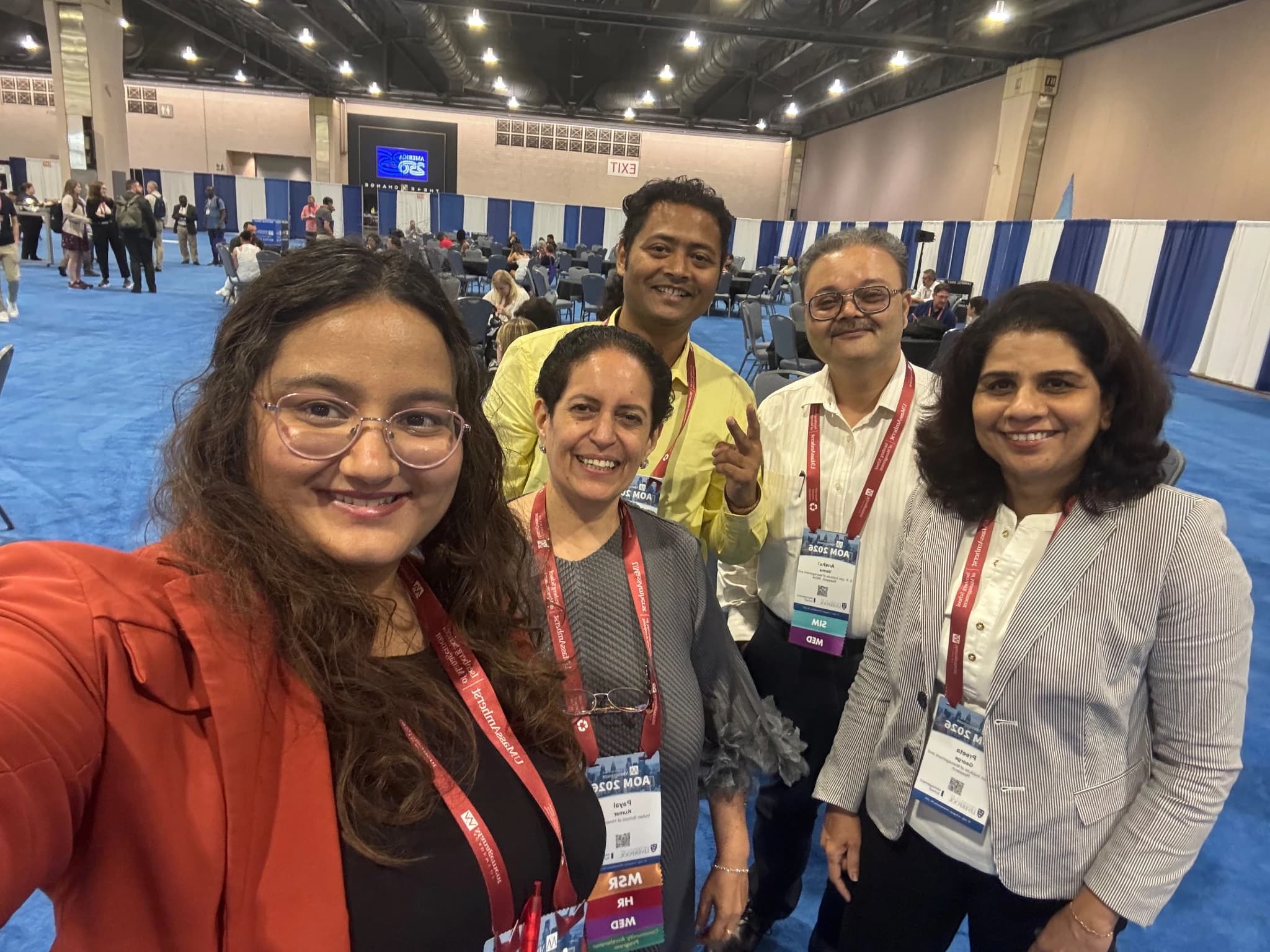
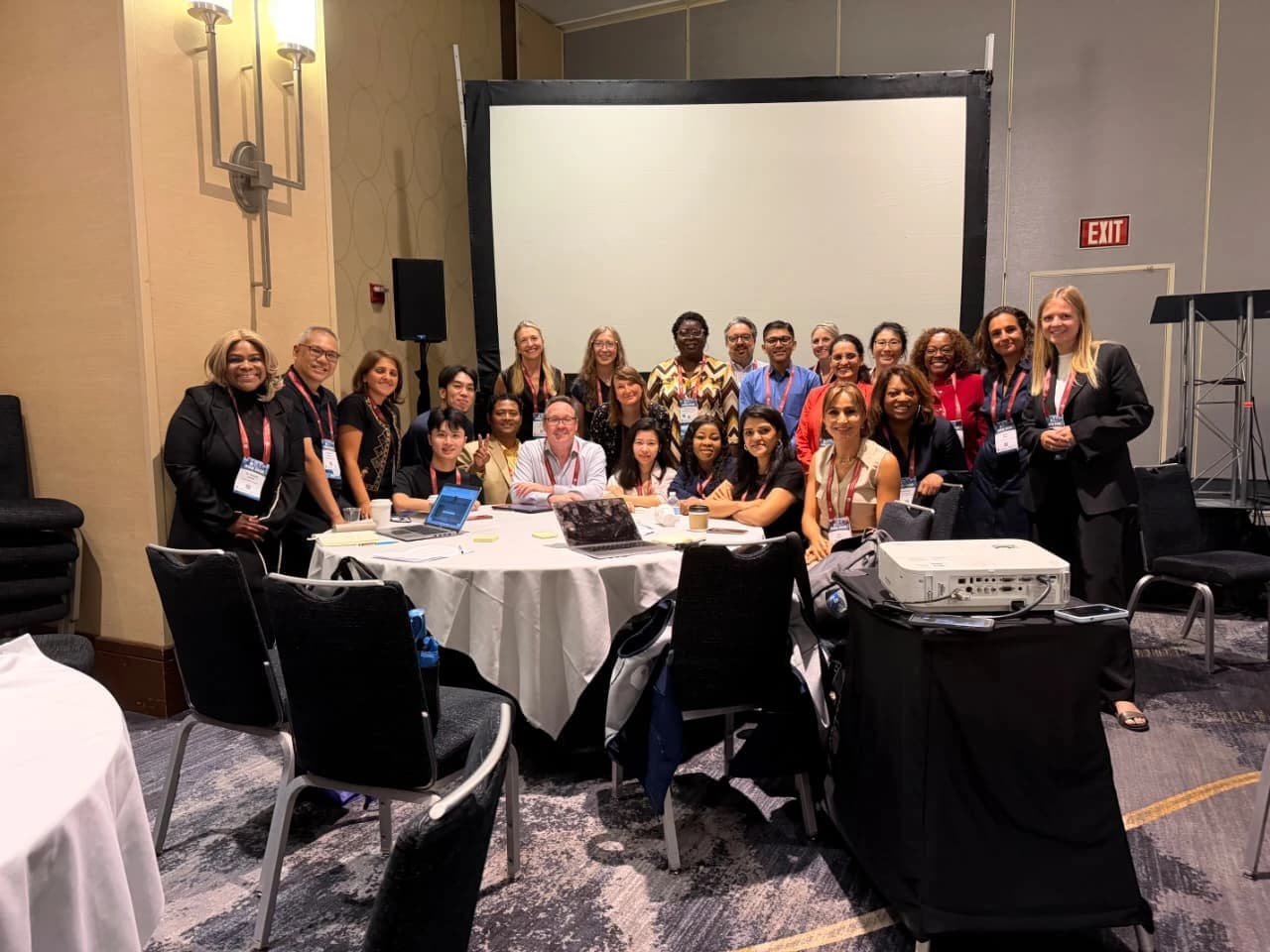
AOM 2026 · Philadelphia Convention Center
With fellow scholars at the Academy of Management gathering in Philadelphia—a warm moment of connection between conversations.
Meeting the Global Scholar Development panel · AOM 2026
With panelists and discussants Dean Shepherd, Madeline Toubiana, Raj Krishnan Shankar, Banu Goktan Bilhan, Magdalena Markowska and Ipek Koparan; coordinator Trenton Williams; and organizer Golshan Javadian, for the AOM Entrepreneurship Division's panel discussion and paper development workshop on “Entrepreneurship Research in Non-WEIRD Contexts.”
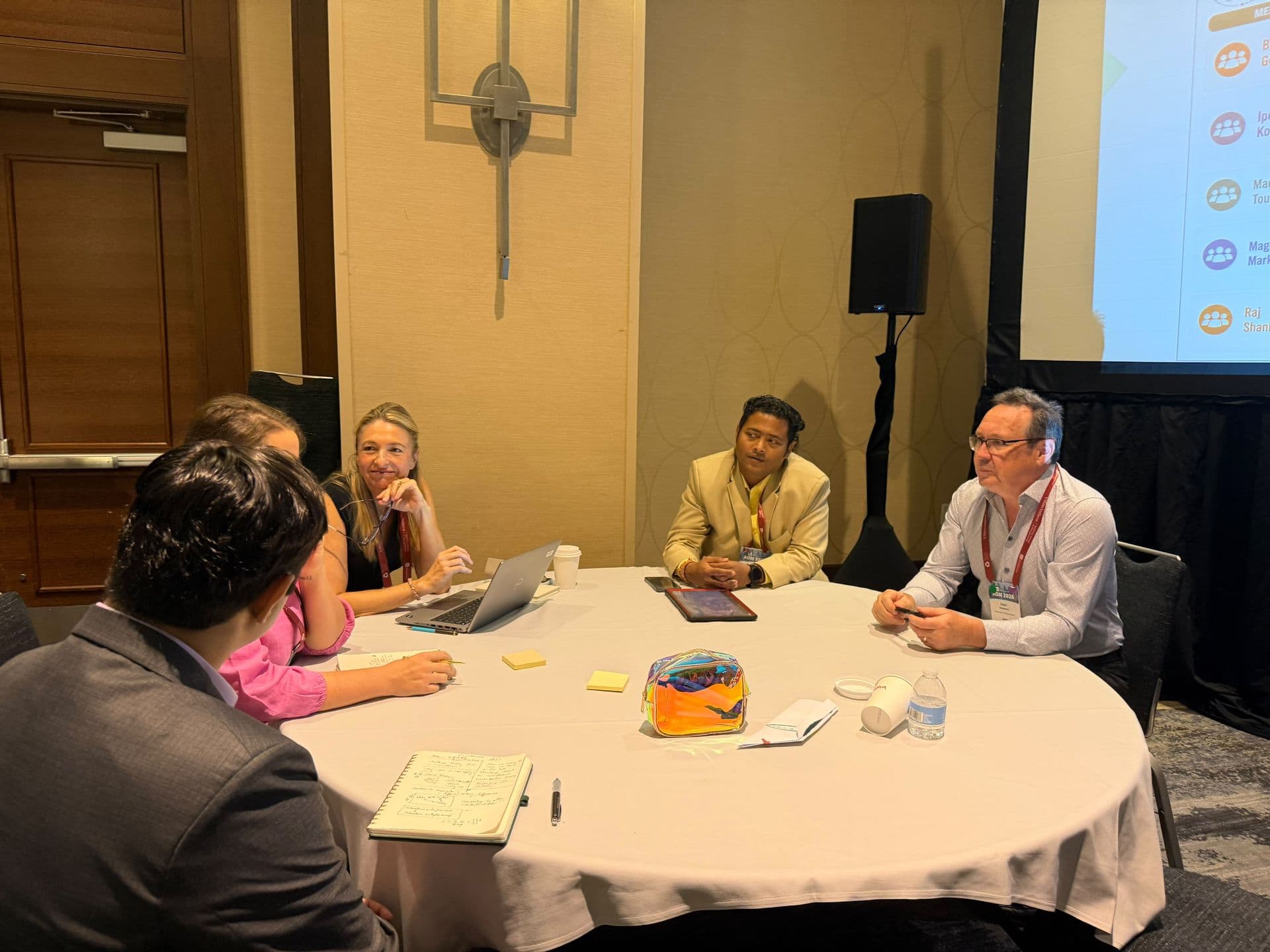
Paper development workshop in progress · AOM 2026
Working through a paper draft with Dean Shepherd and fellow scholars at the Global Scholar Development Committee's interactive workshop on entrepreneurship research in non-WEIRD contexts.
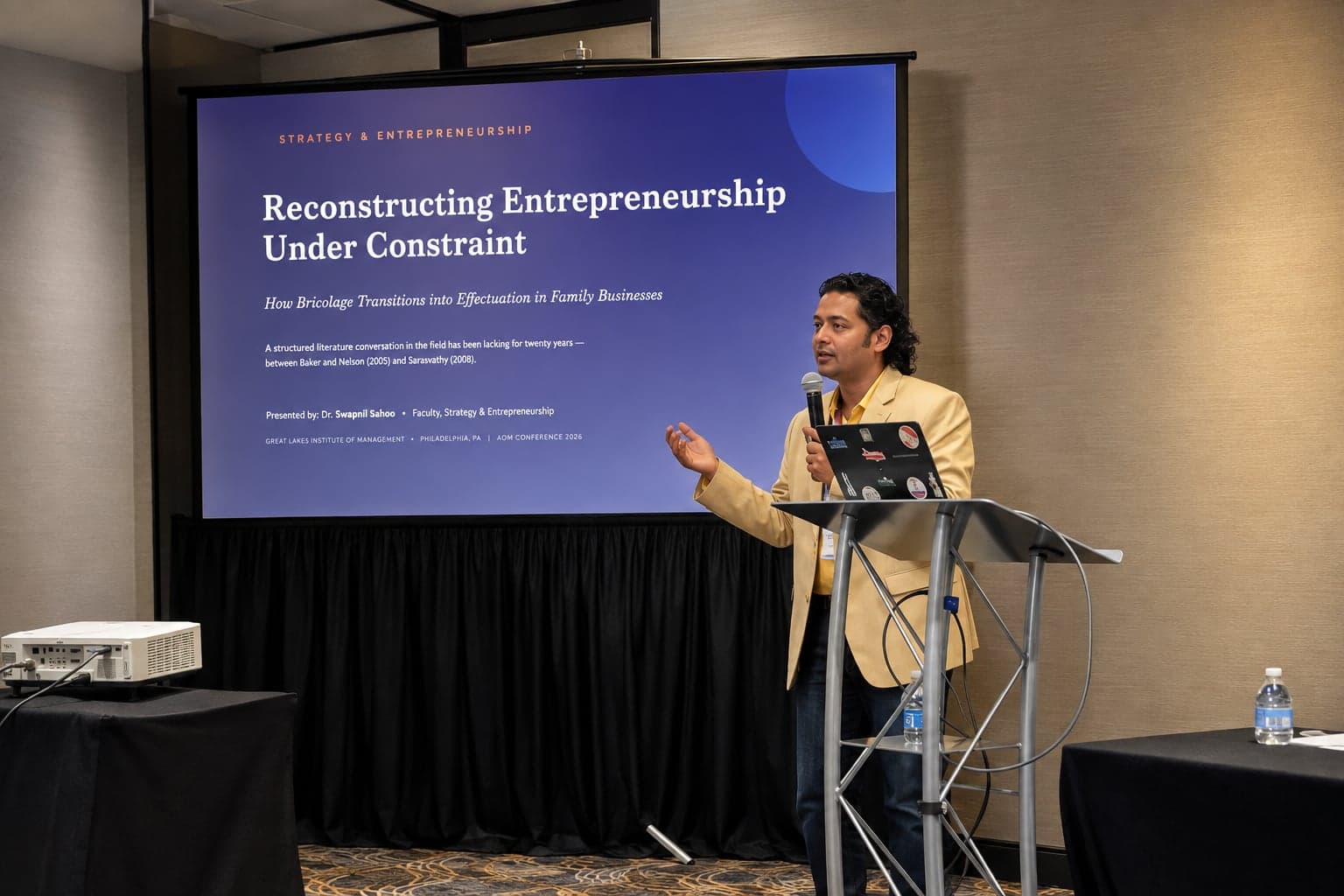
Presenting entrepreneurship under constraint · AOM 2026
Presenting ‘Entrepreneurship Under Constraint: How Bricolage Transitions into Effectuation in Family Businesses,’ co-authored with Munish Thakur.
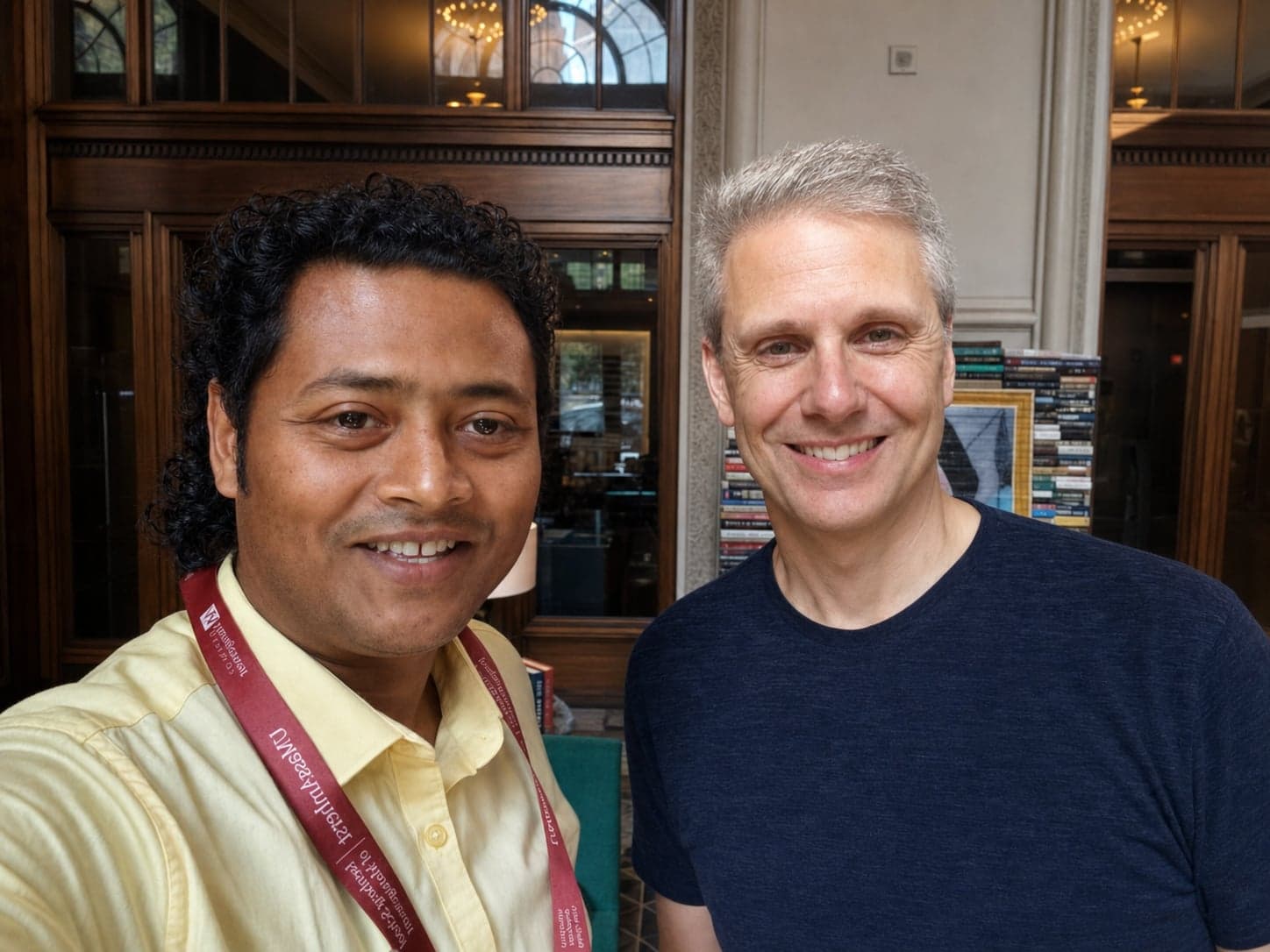
With Prof. J.P. Eggers · AOM 2026
“The best conversations do not close questions; they give them a more interesting future.”
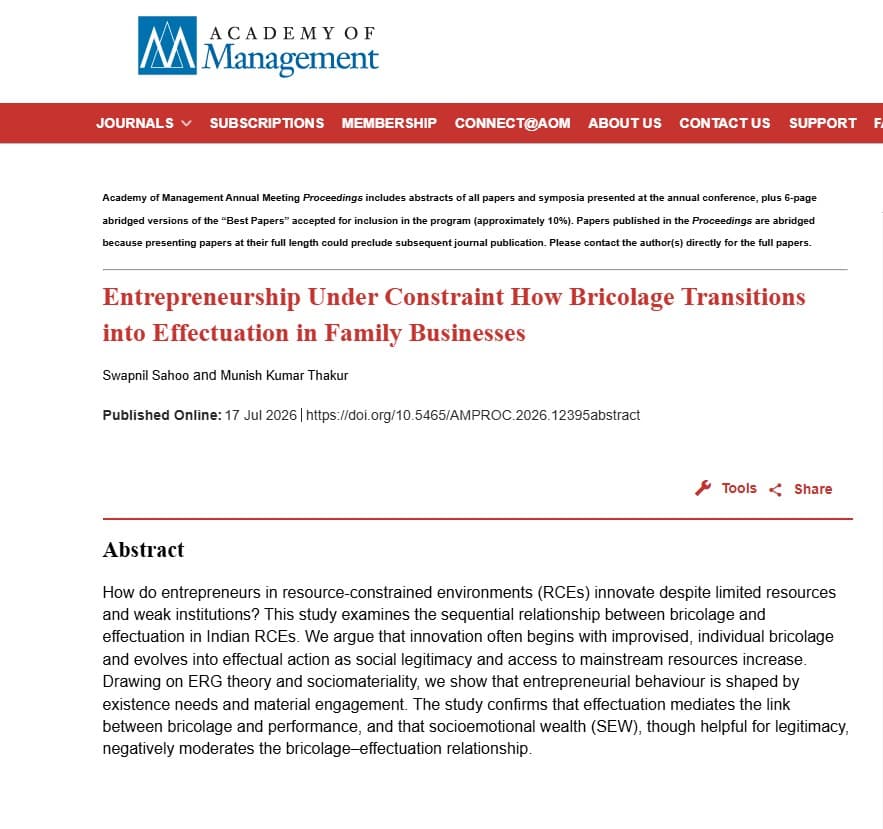
Published in AOM Proceedings · AOM 2026
“Entrepreneurship Under Constraint: How Bricolage Transitions into Effectuation in Family Businesses,” with Munish Thakur, published online 17 Jul 2026.
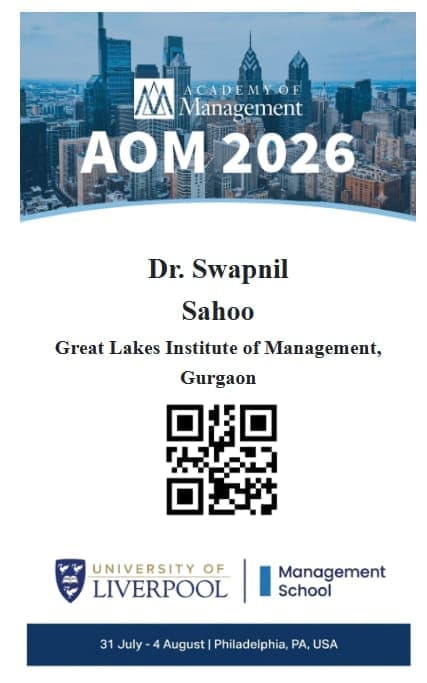
Conference badge · 86th AOM Annual Meeting
Presenting on firms that begin with almost nothing, and how the improvising slowly hands over to something more deliberate as relationships and standing build up. Tuesday, 4 August, Philadelphia Marriott Downtown, Franklin 8.
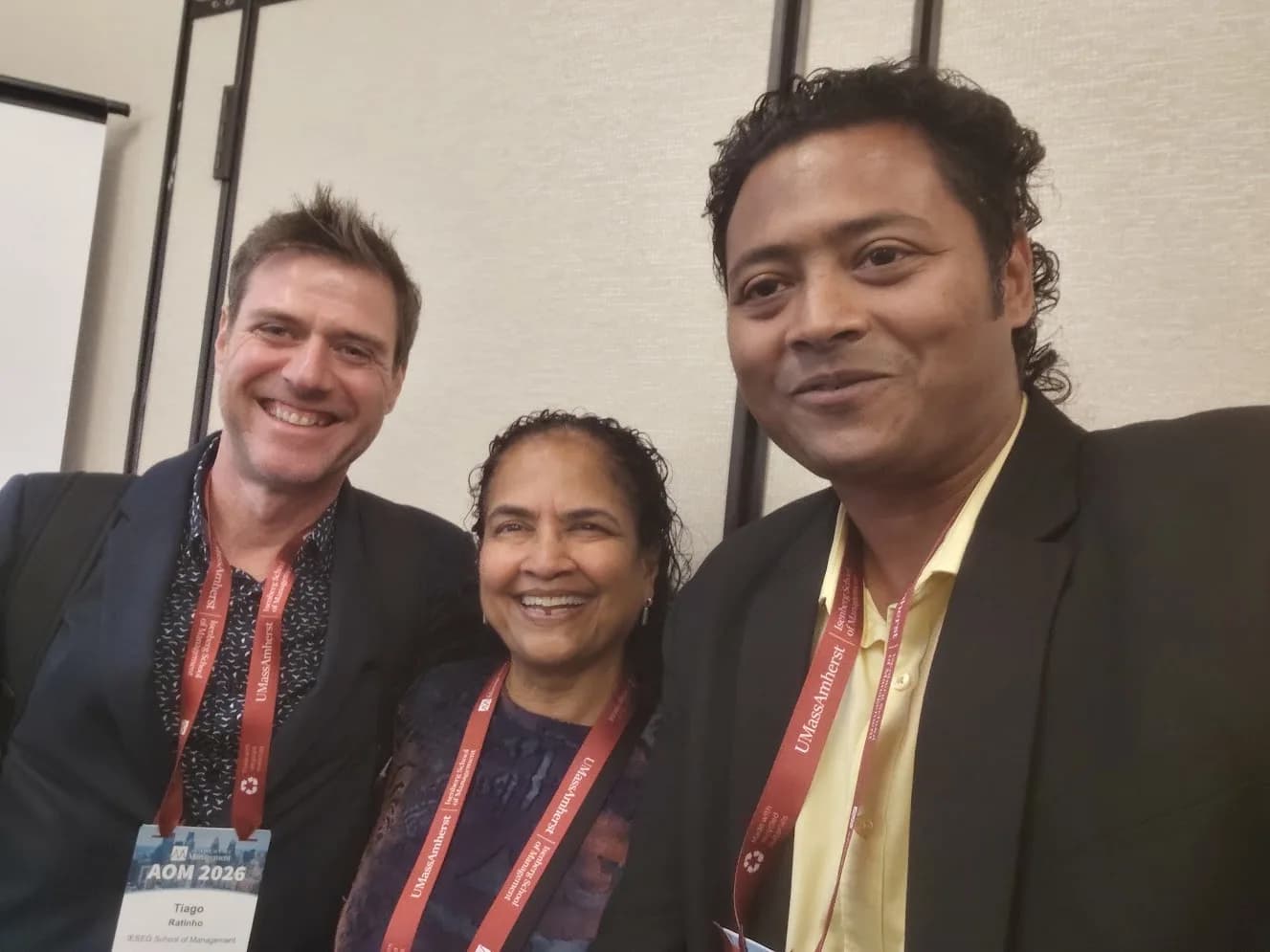
Meeting Prof. Saras Sarasvathy · AOM 2026
Much of my doctoral research has been shaped by effectuation, so meeting the scholar whose work influenced my dissertation was a first-AOM moment I'll remember. She later sat with me, discussed the papers in detail, and offered candid feedback that changed how I see parts of the work. With Tiago Ratinho, generous throughout the conversation.
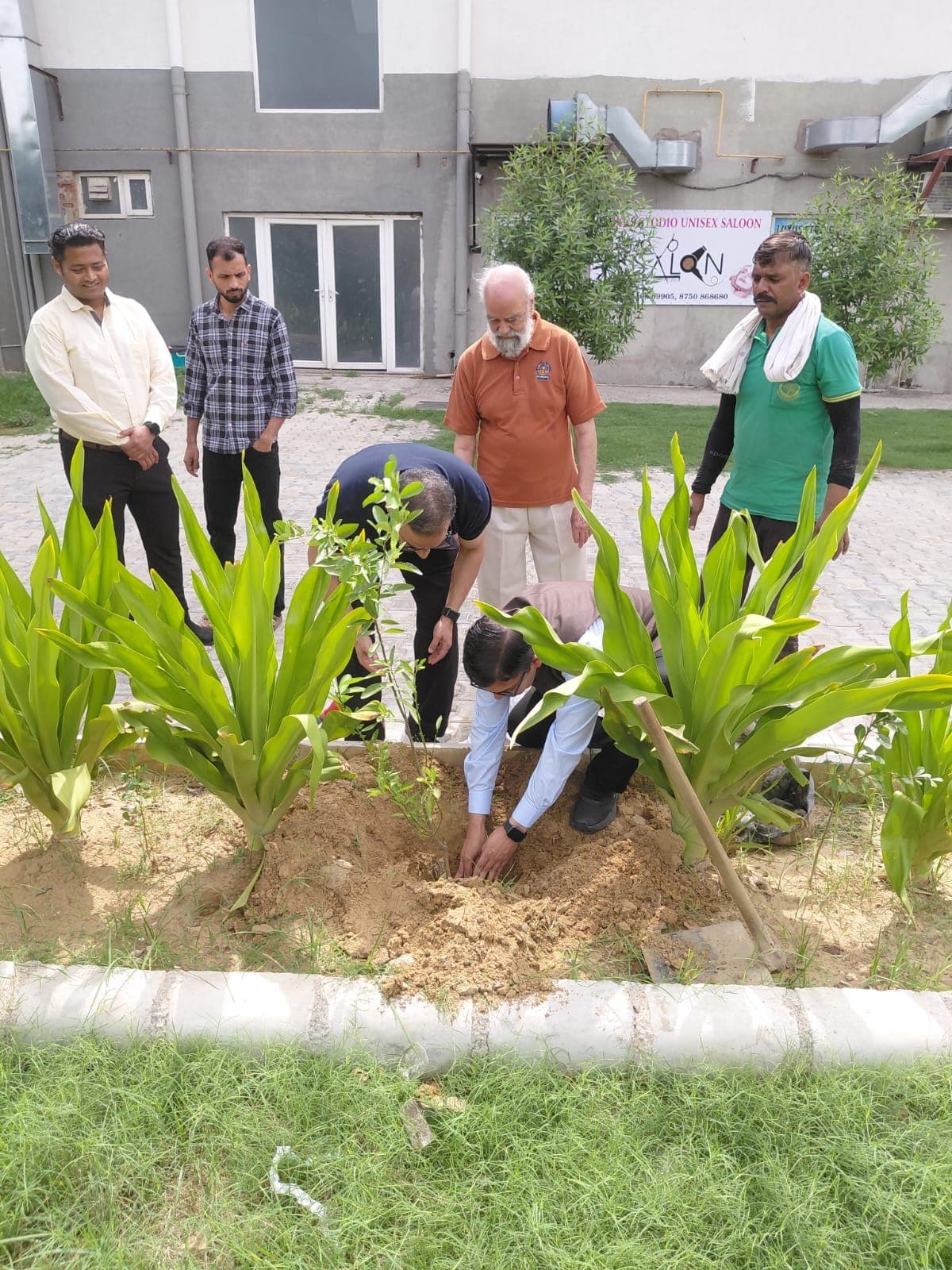
Tree plantation · Great Lakes Gurgaon campus
Dr. Sudhakar and Dr. Raj planting a sacred ginkgo tree from Japan and a citrus fruit tree on campus.
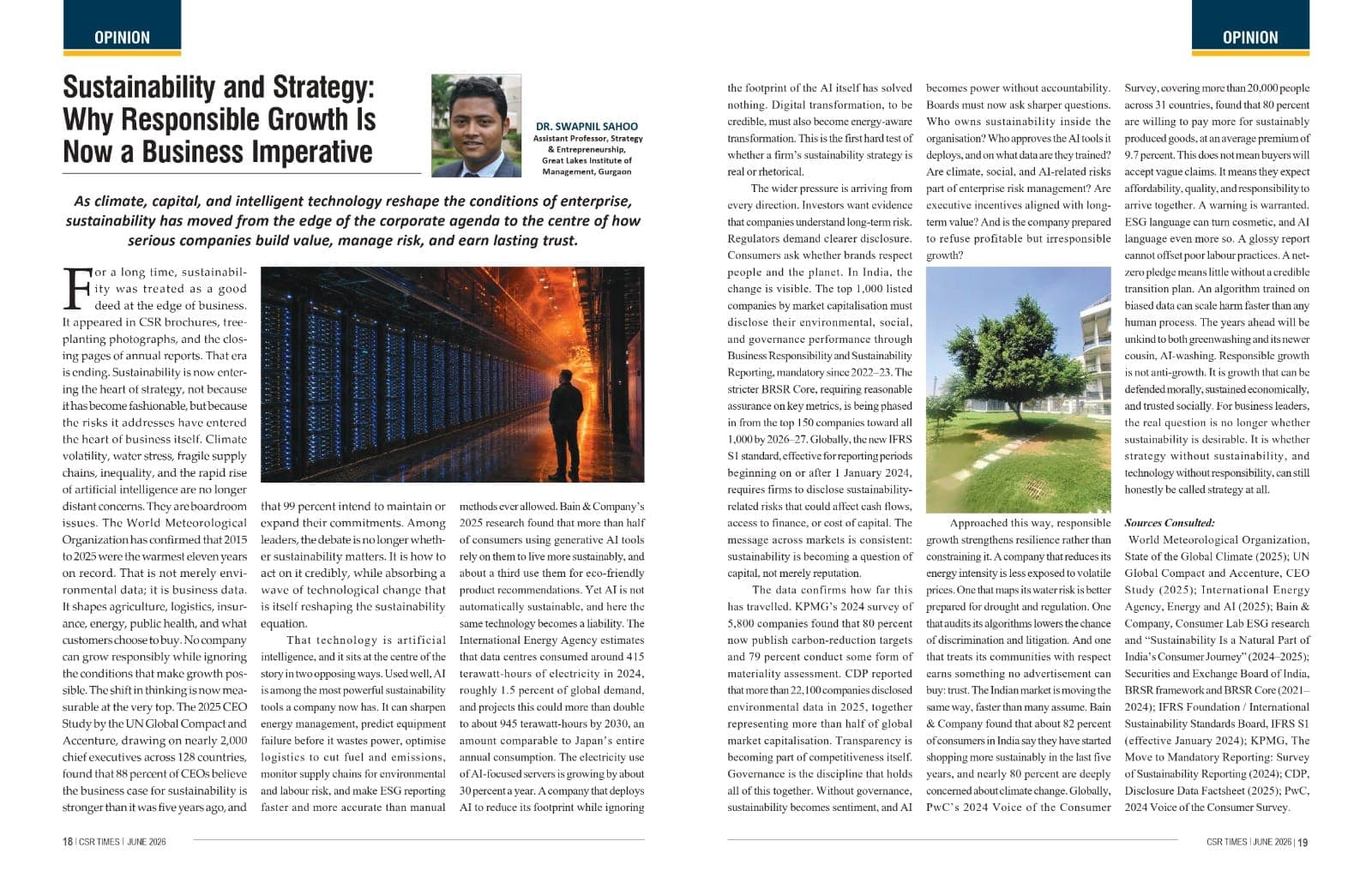
Published in CSR Times · June 2026
An essay on AI's sustainability paradox: it can cut waste and sharpen ESG reporting, even as its own energy footprint raises real questions about responsible digital transformation.
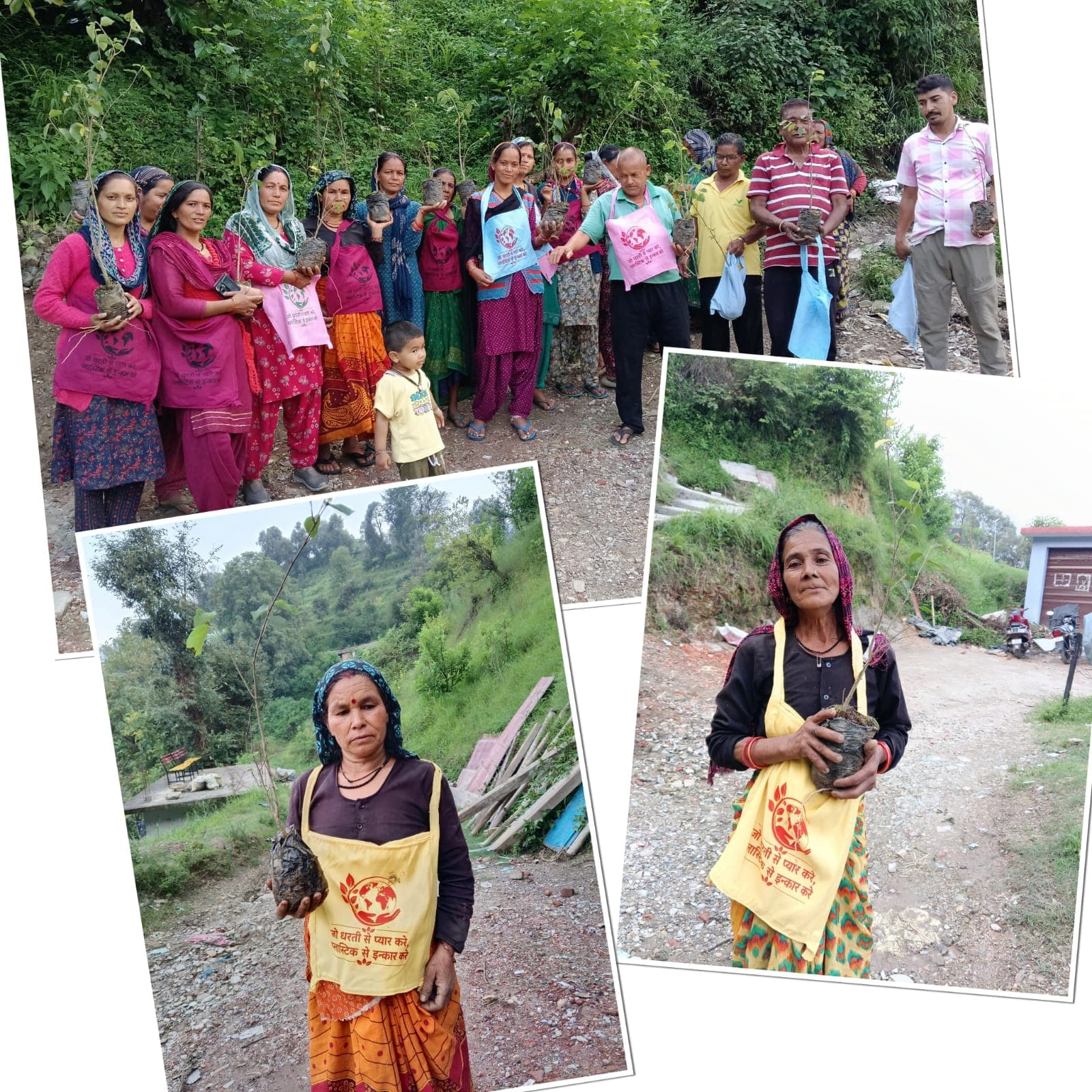
Reuse over plastic · Salinga & Mehalchauri
Used hostel bedsheets repurposed into durable carry bags and distributed to residents of Salinga and Mehalchauri alongside saplings—cutting textile waste while replacing single-use plastic.
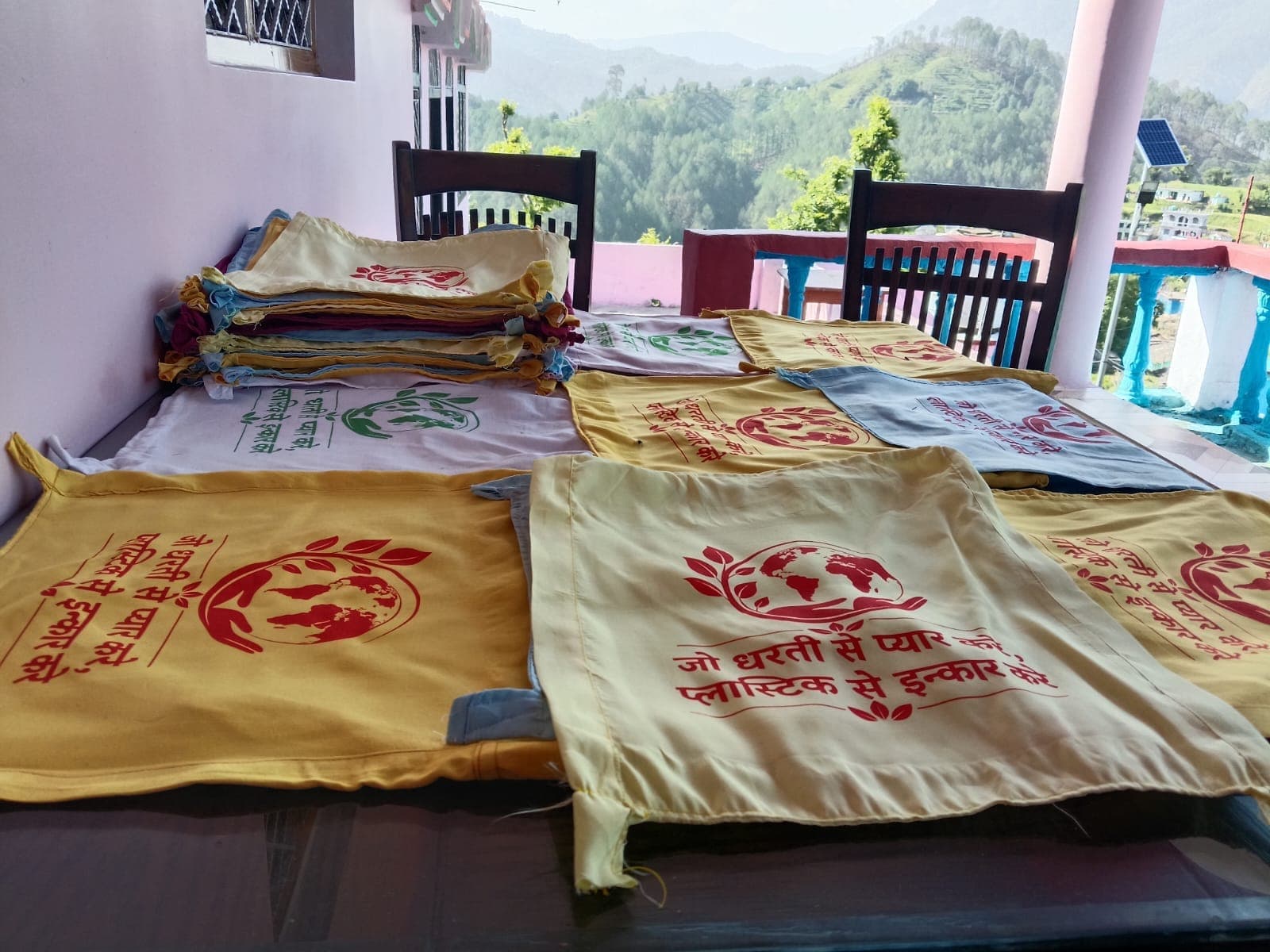
Ready for distribution · Salinga & Mehalchauri
The finished bags, each printed with the message “those who love the earth refuse plastic,” before handover to village residents.
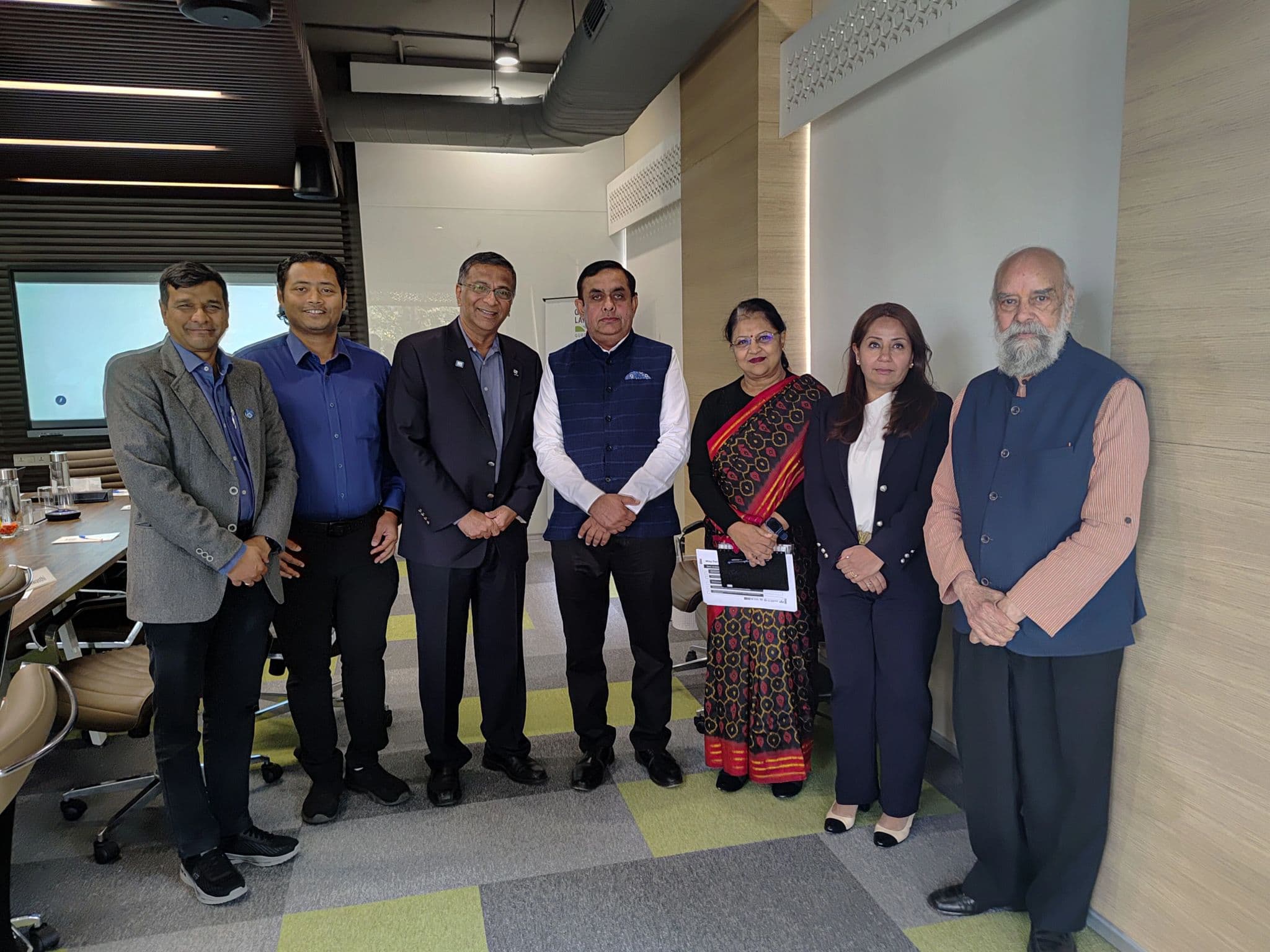
AACSB peer review visit · Societal impact in dialogue
With Dr. Raju Balakrishnan and Great Lakes colleagues—connecting Karma Yoga and the Sustainability CoE with SDG 4 and SDG 11.
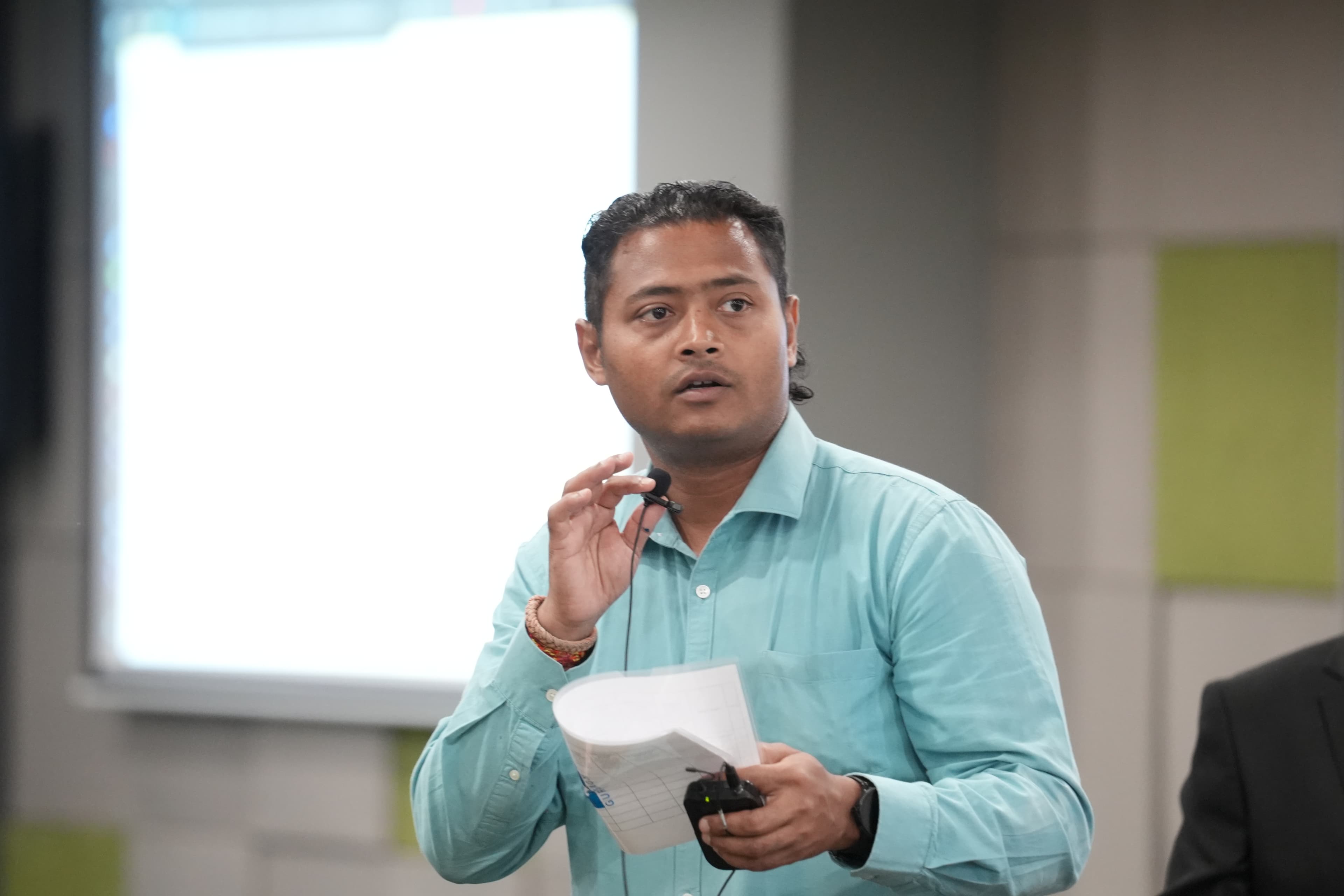
Explaining the build · AI Mini Hackathon
Dr Swapnil Sahoo speaks during the 5 July final. Camera-original event photograph; photographer not identified.
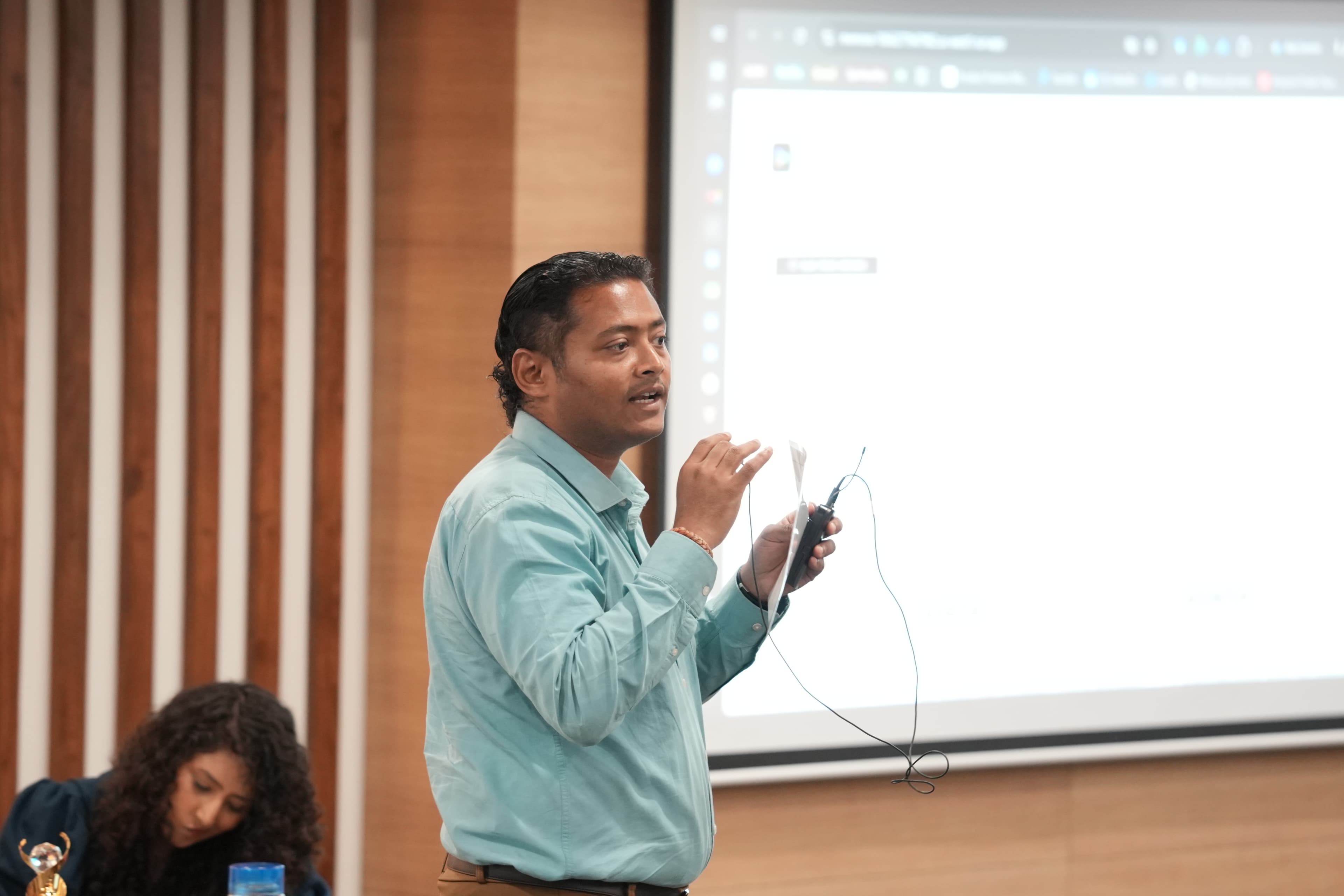
Inside the final room · AI Mini Hackathon
A live teaching moment during the 5 July final. Camera-original event photograph; photographer not identified.
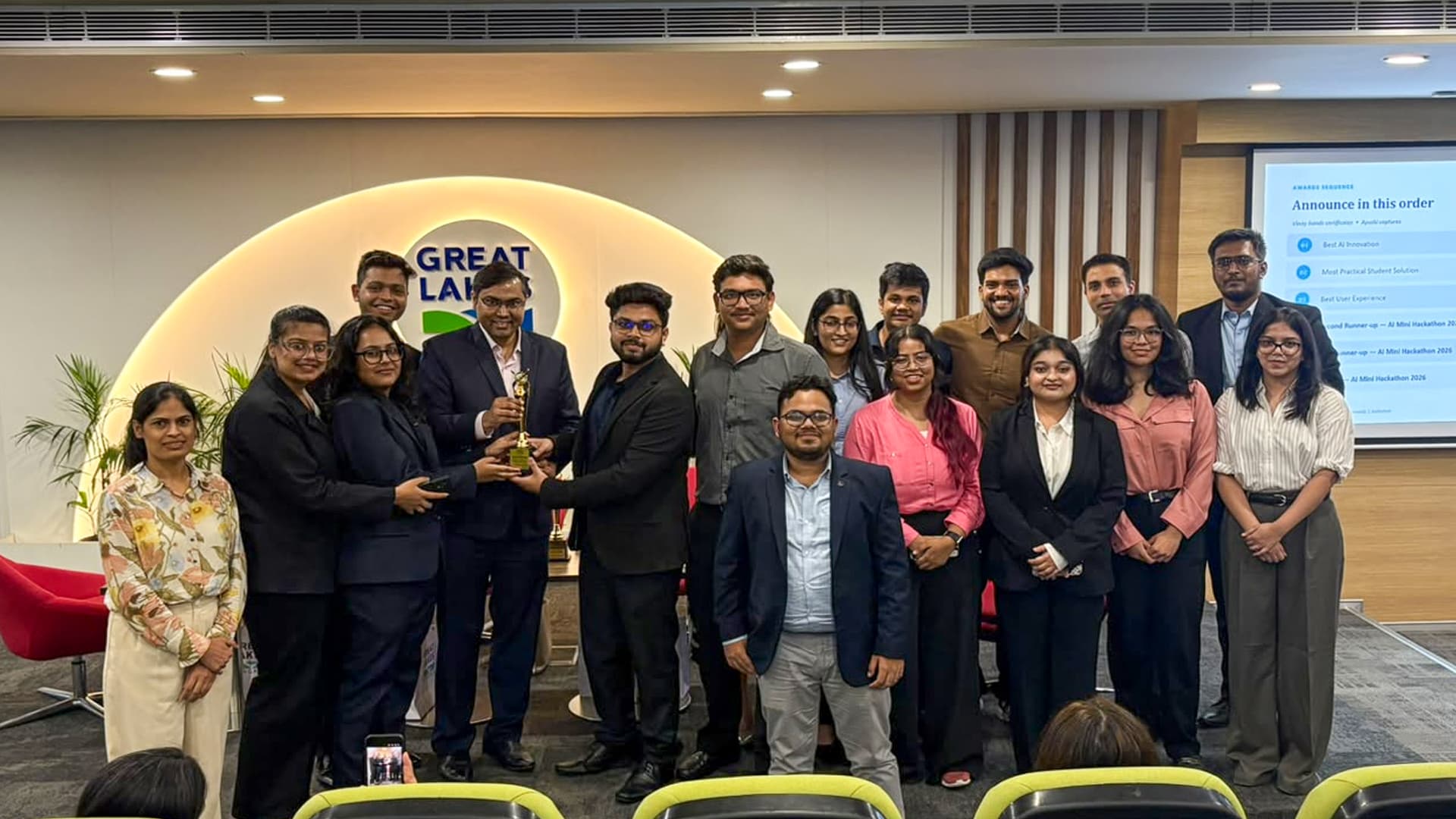
AI Mini Hackathon 2026 · Awards and applause
Students and faculty celebrate a winning prototype team at Great Lakes Gurgaon. Event media shared by the Great Lakes Gurgaon programme team; photographer not identified.
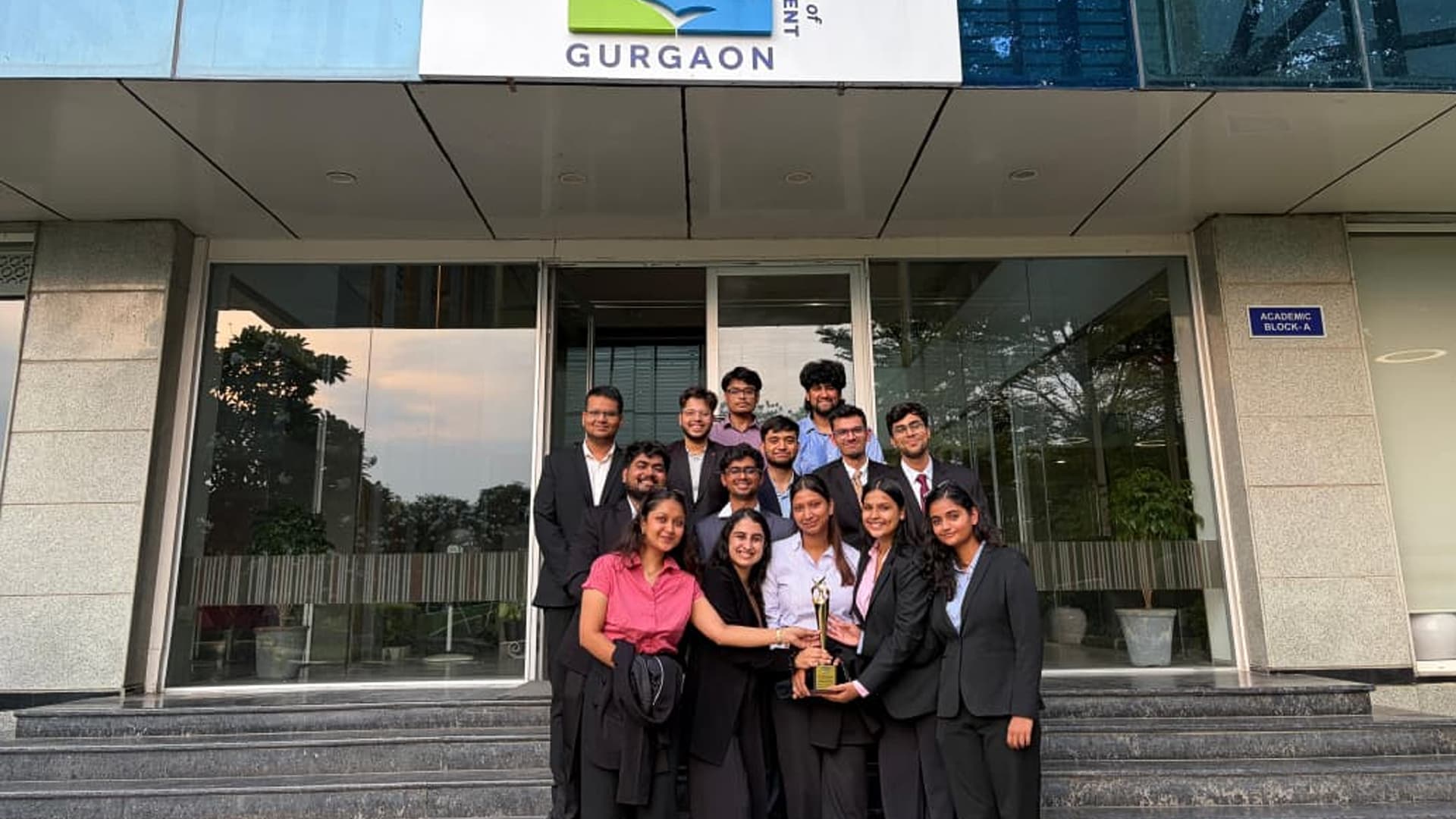
From prototype to podium · AI Mini Hackathon 2026
A student team marks its achievement together on campus. Event media shared by the Great Lakes Gurgaon programme team; photographer not identified.
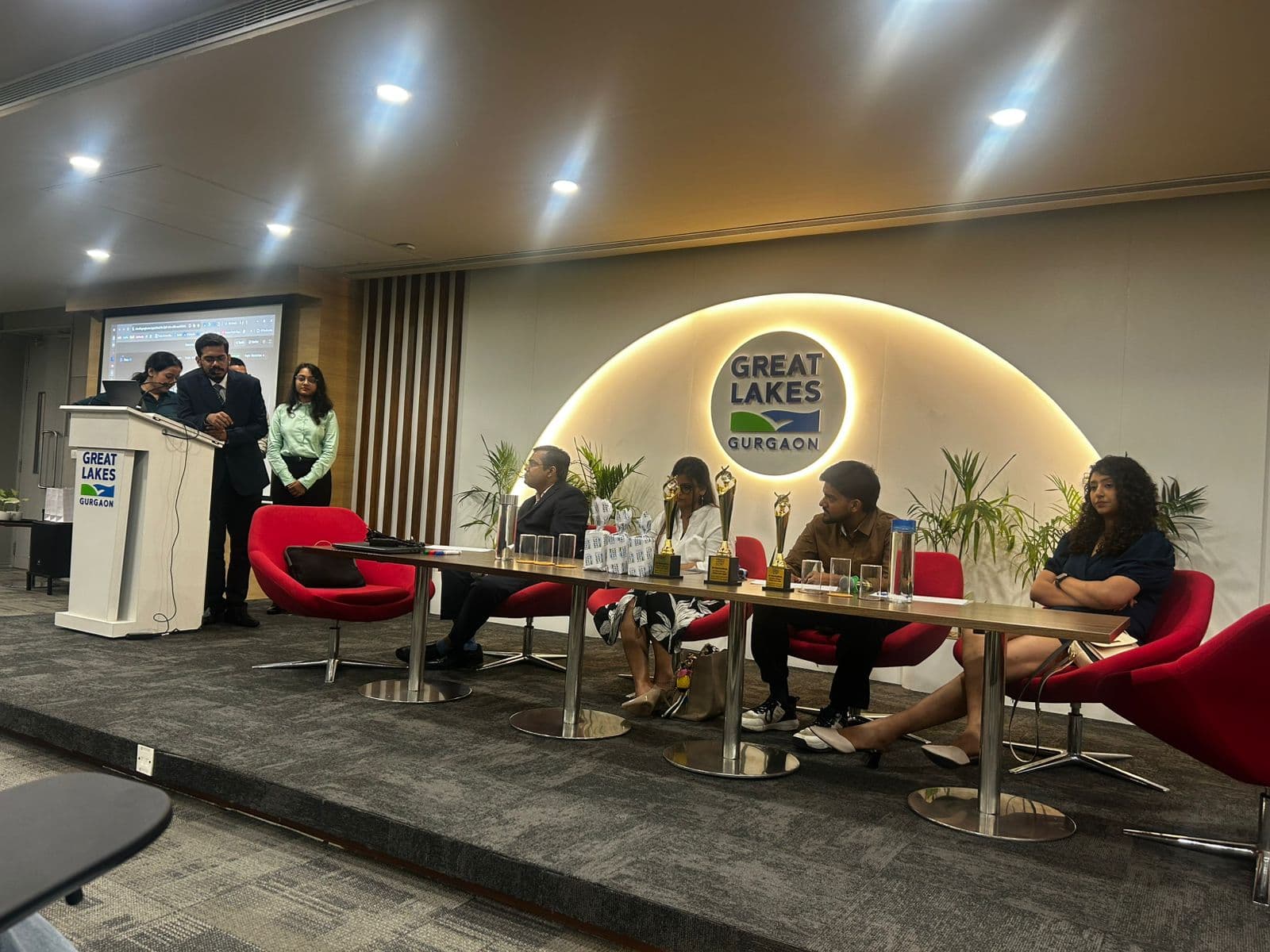
Jury panel · AI Mini Hackathon 2026
Judges review pitches and prepare to award the trophies at the close of the finals.
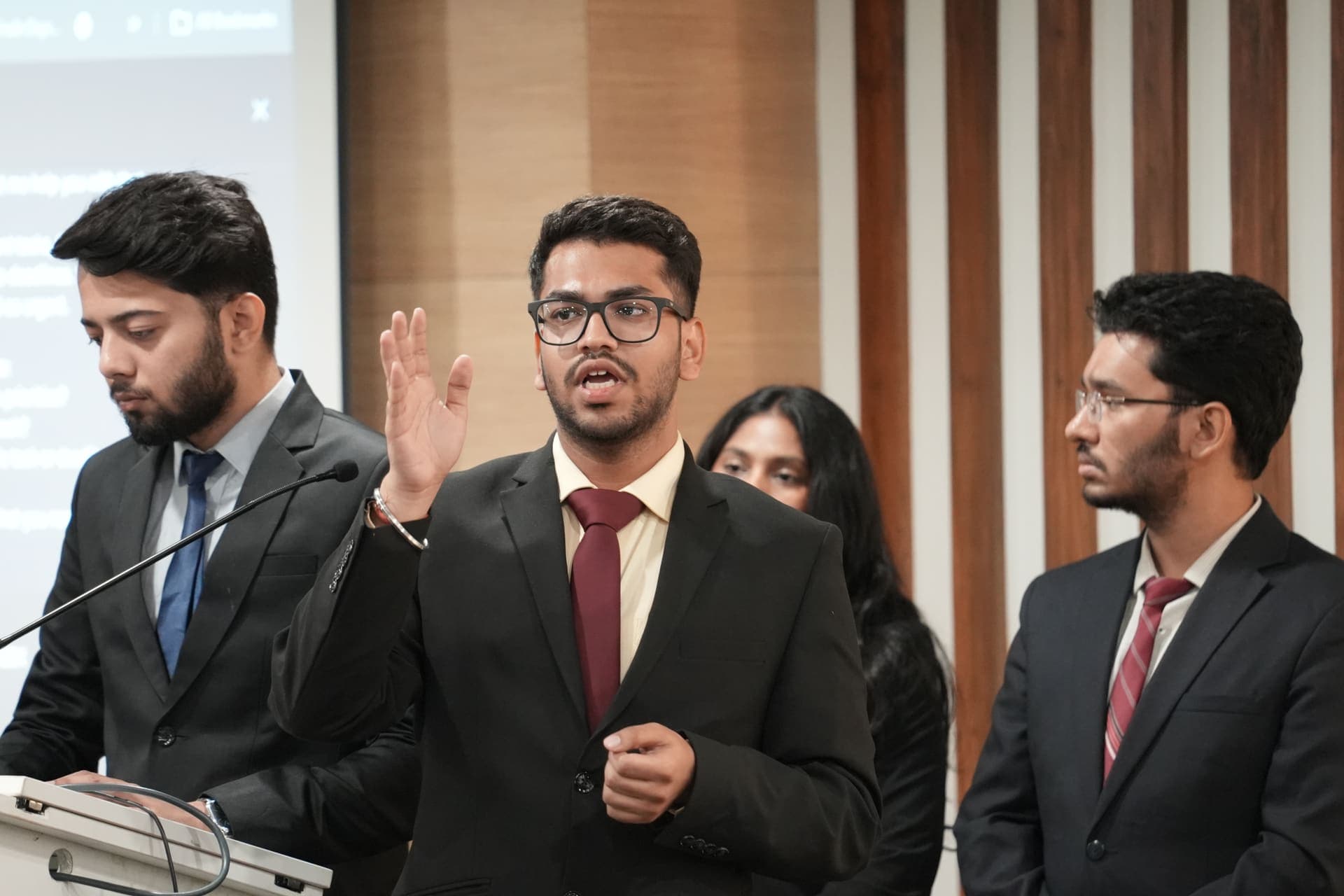
Making the case, live · AI Mini Hackathon 2026 final
A team presenter mid-pitch at the 5 July 2026 final, with teammates standing by for questions.
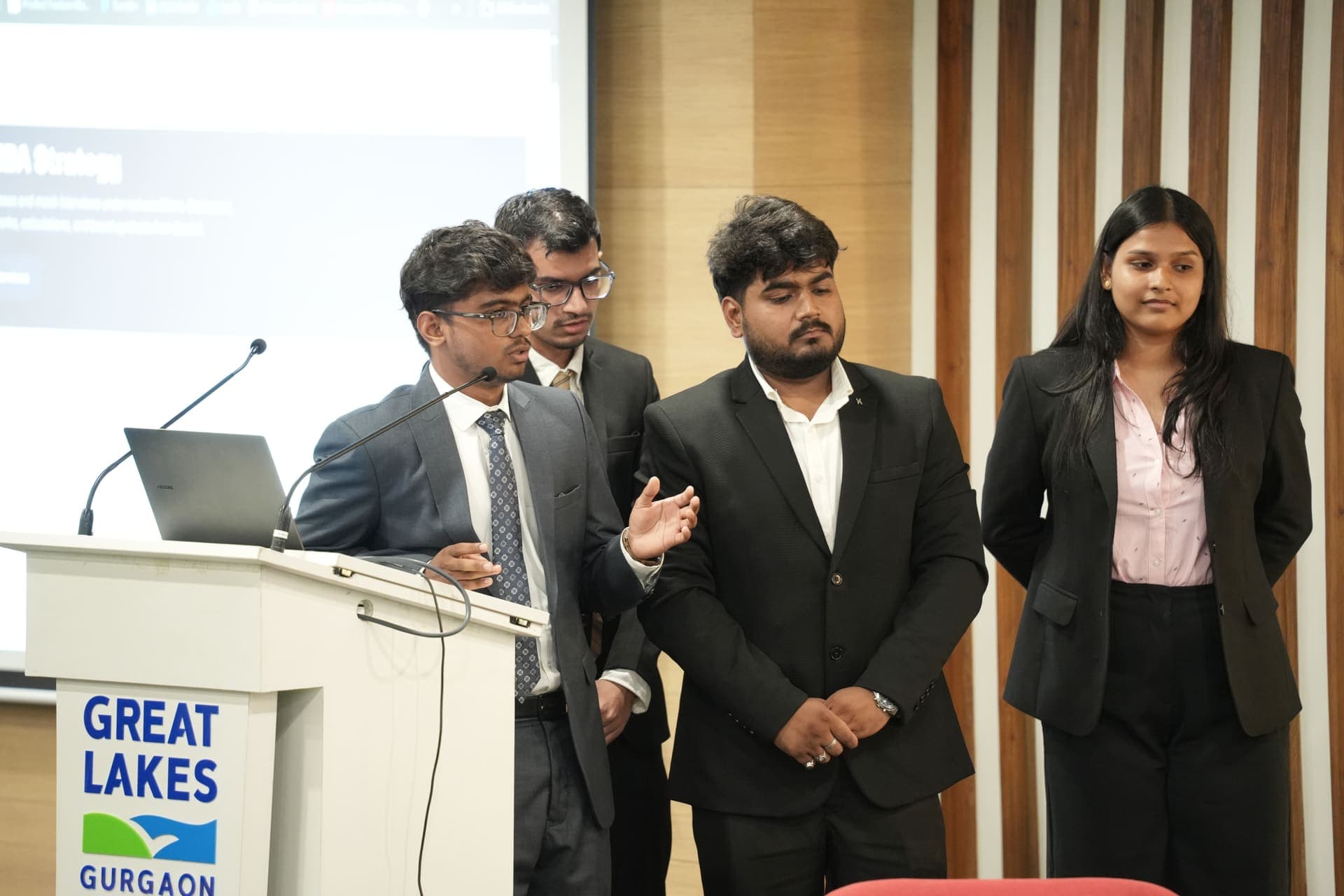
At the podium · AI Mini Hackathon 2026 final
A full team at the podium during the final — one presenter speaking, the rest ready to field questions.
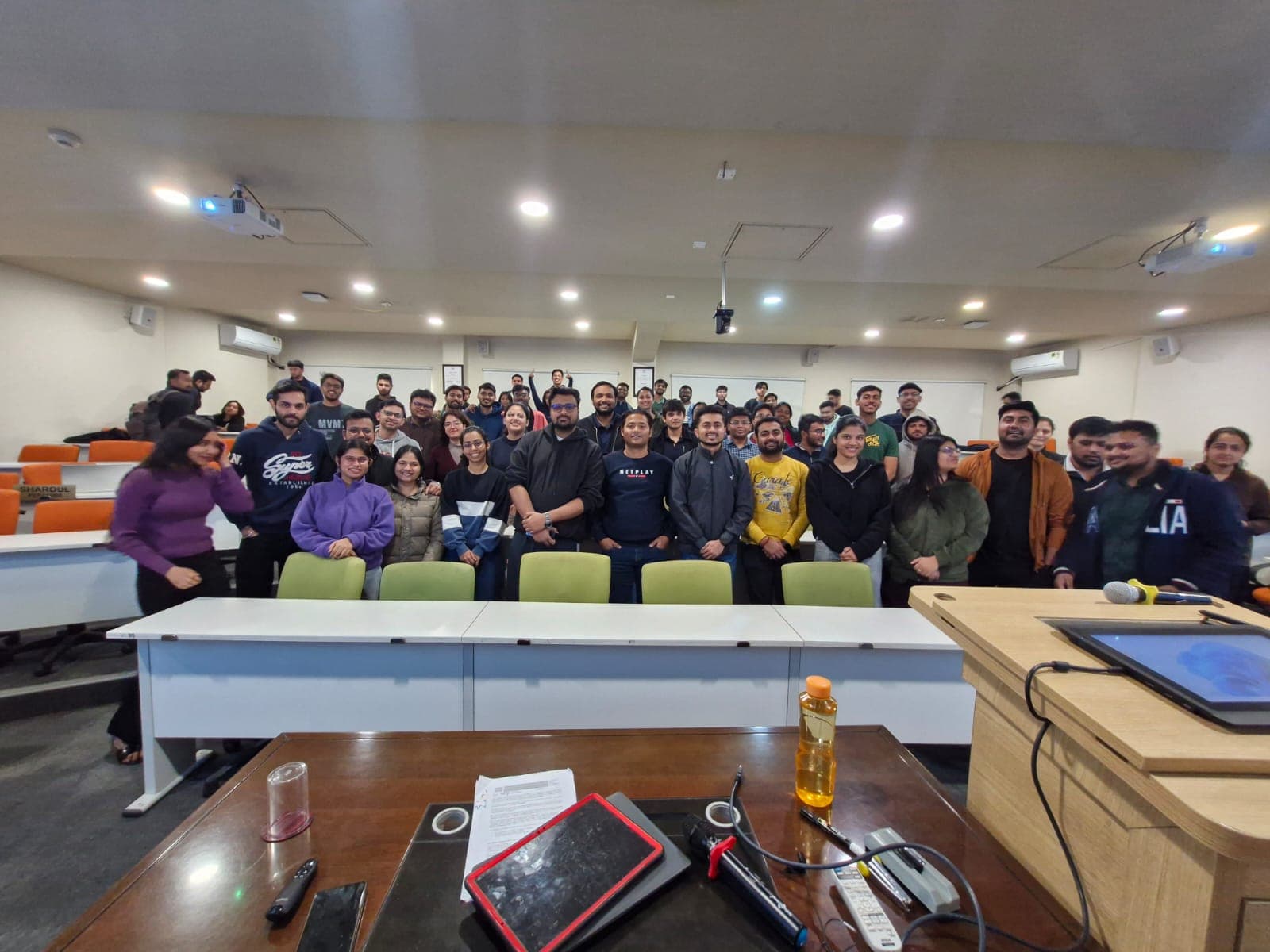
Strategic Management · Course closure
The 2-Year MBA cohort marking the end of the course together in the classroom.
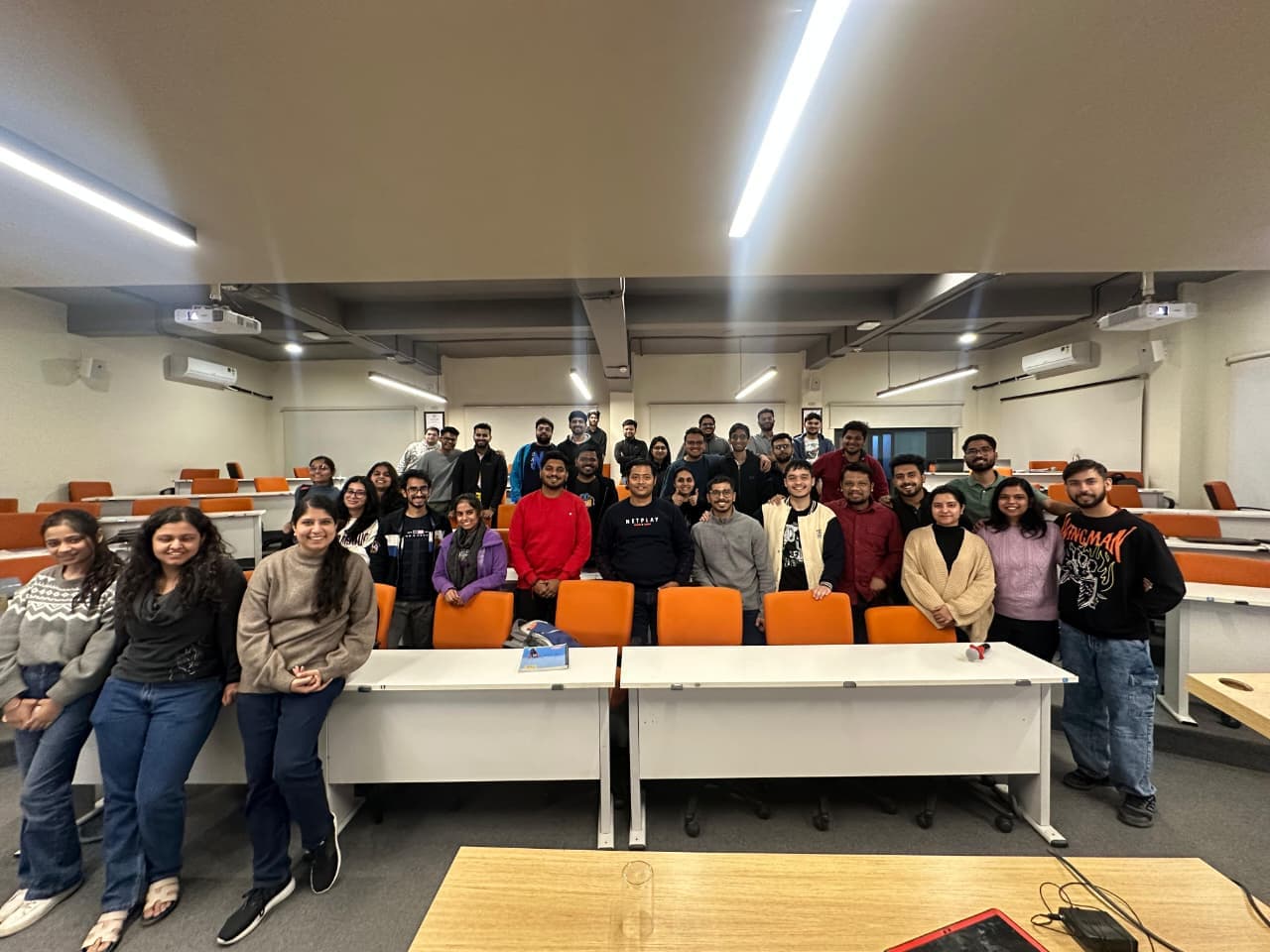
Strategic Management · Course closure
Another Strategic Management cohort at their own course-closure group photo.
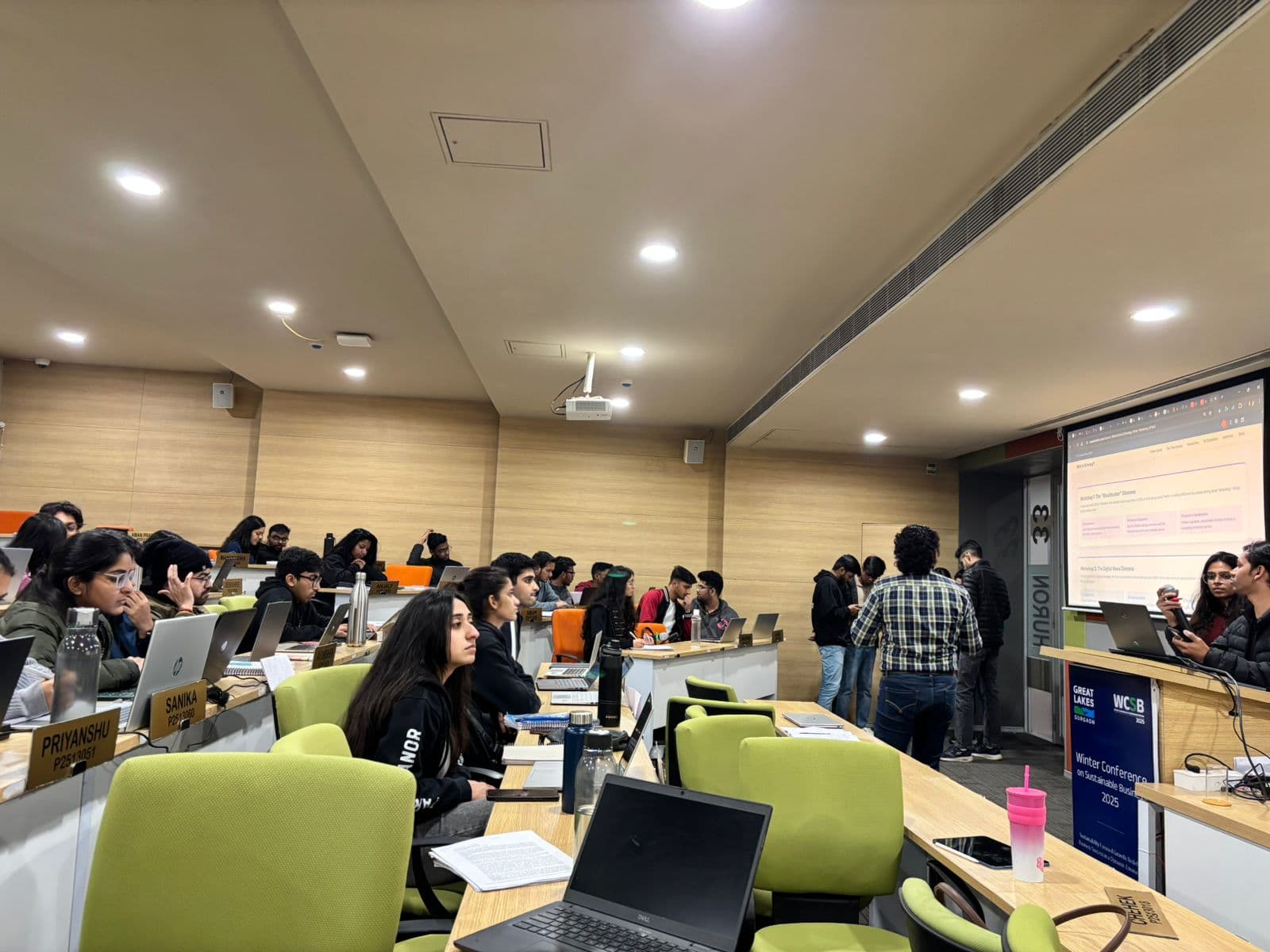
Winter Conference on Sustainable Business · 2025
Teams present workshop findings on the classroom screens during the Winter Conference on Sustainable Business.
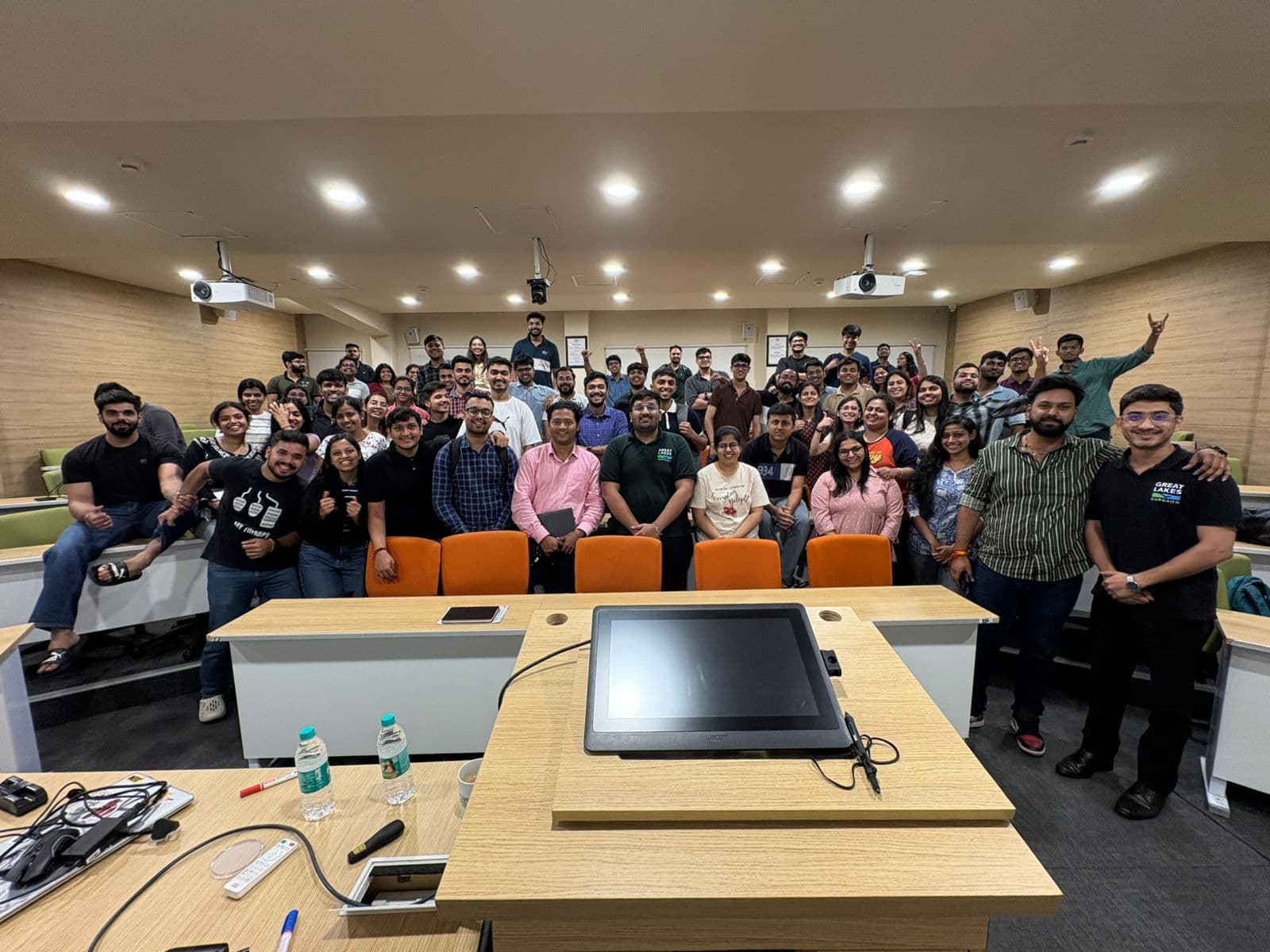
Strategy cohort · September 2025
A full-class group photo at the end of a Strategy session.
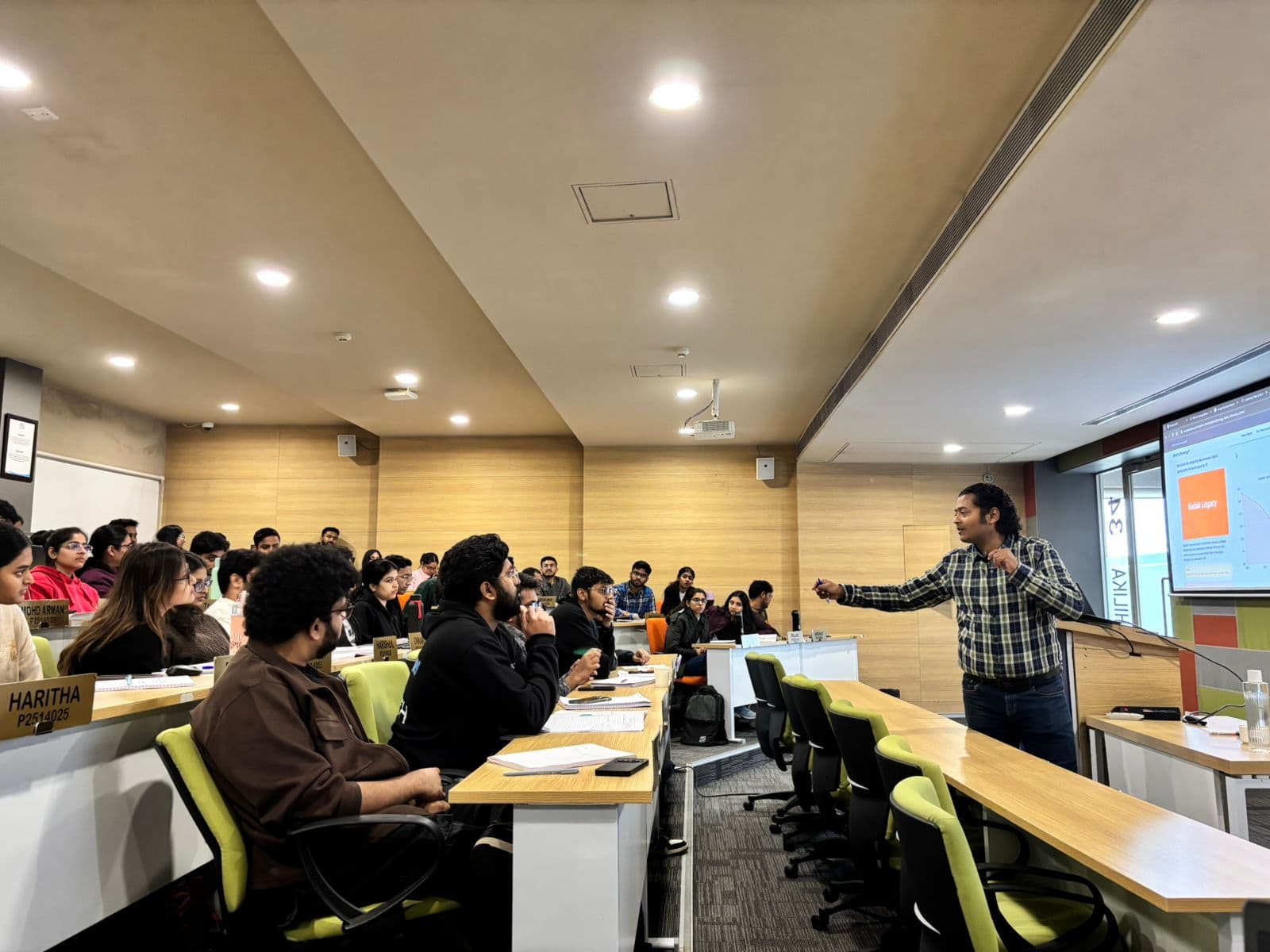
Teaching the Kodak case · Strategy, January 2026
A live case-teaching moment on Kodak's strategic legacy.
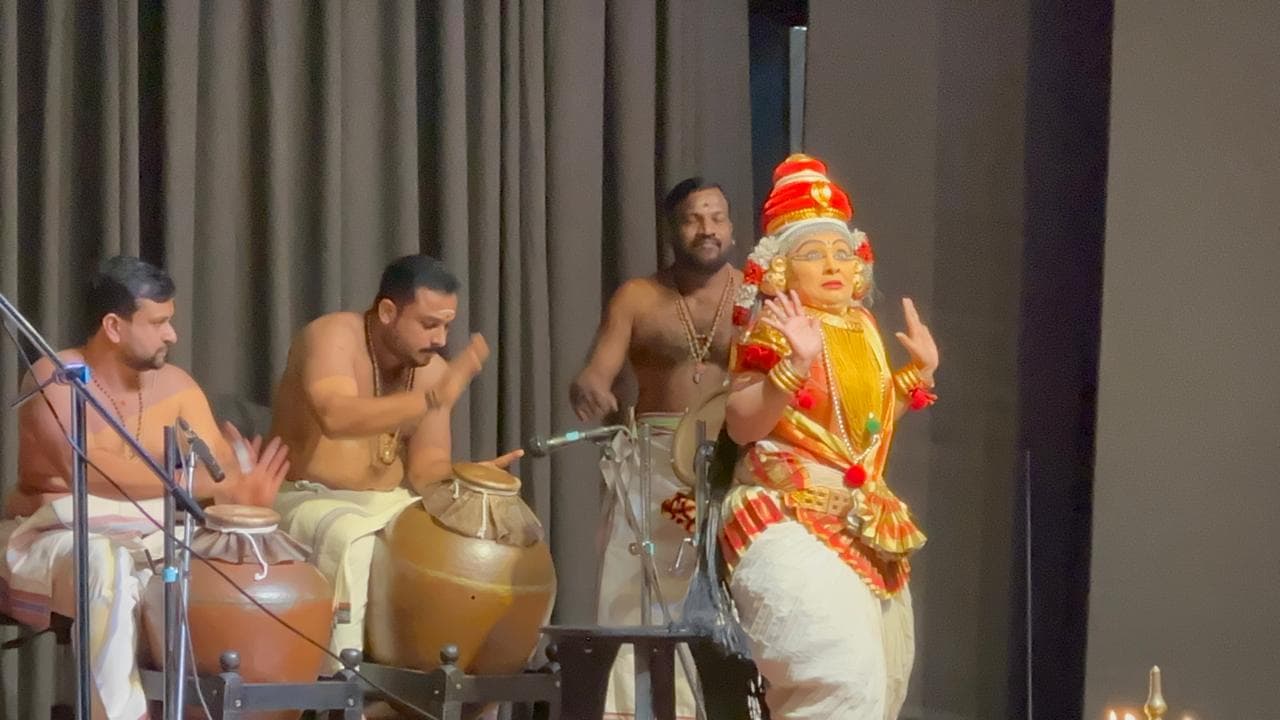
Koodiyattam · SPIC MACAY cultural evening, November 2025
A classical Koodiyattam performance hosted by the SPIC MACAY chapter at Great Lakes Gurgaon.
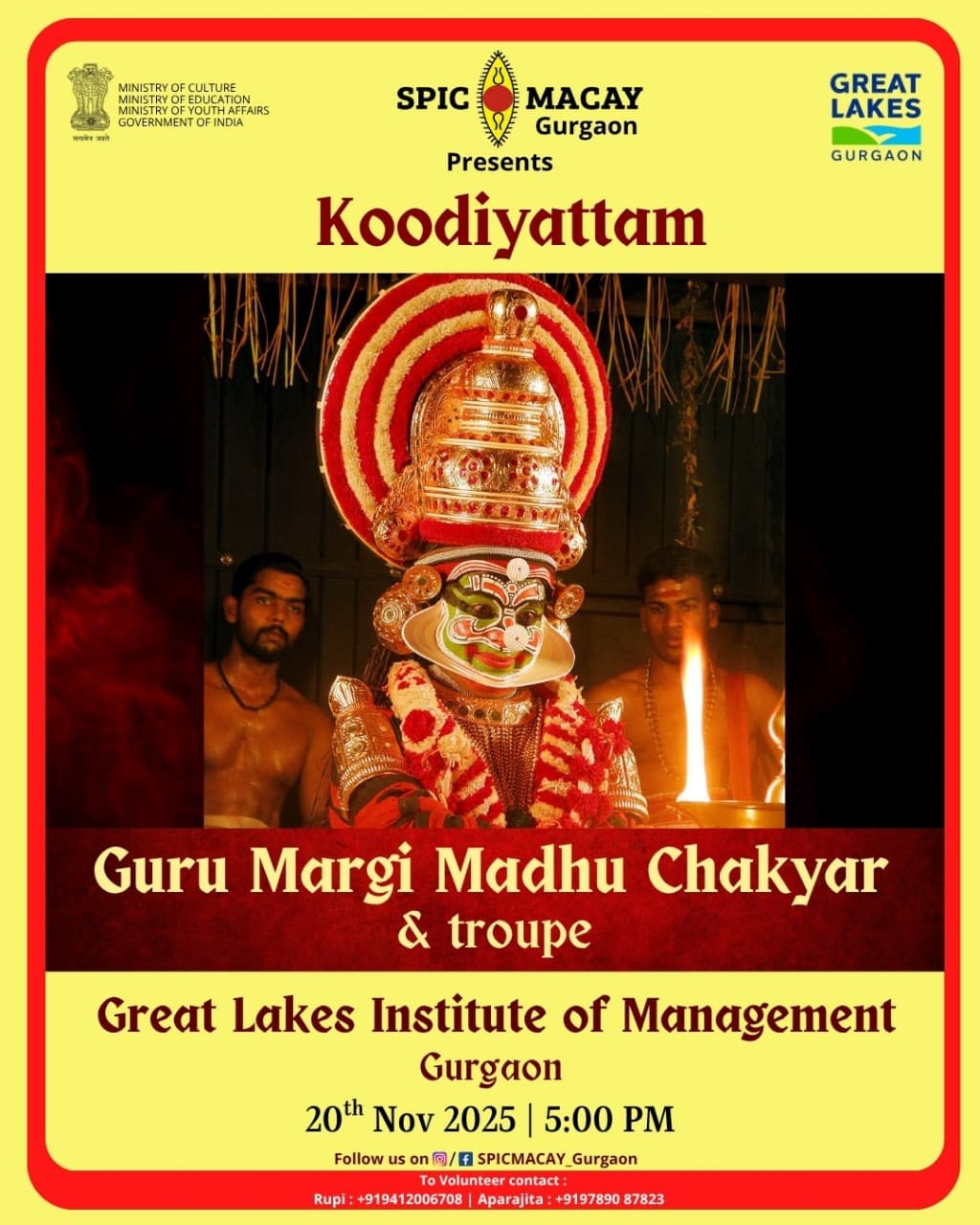
SPIC MACAY · Bringing classical arts to campus
The official poster for the Koodiyattam cultural evening.
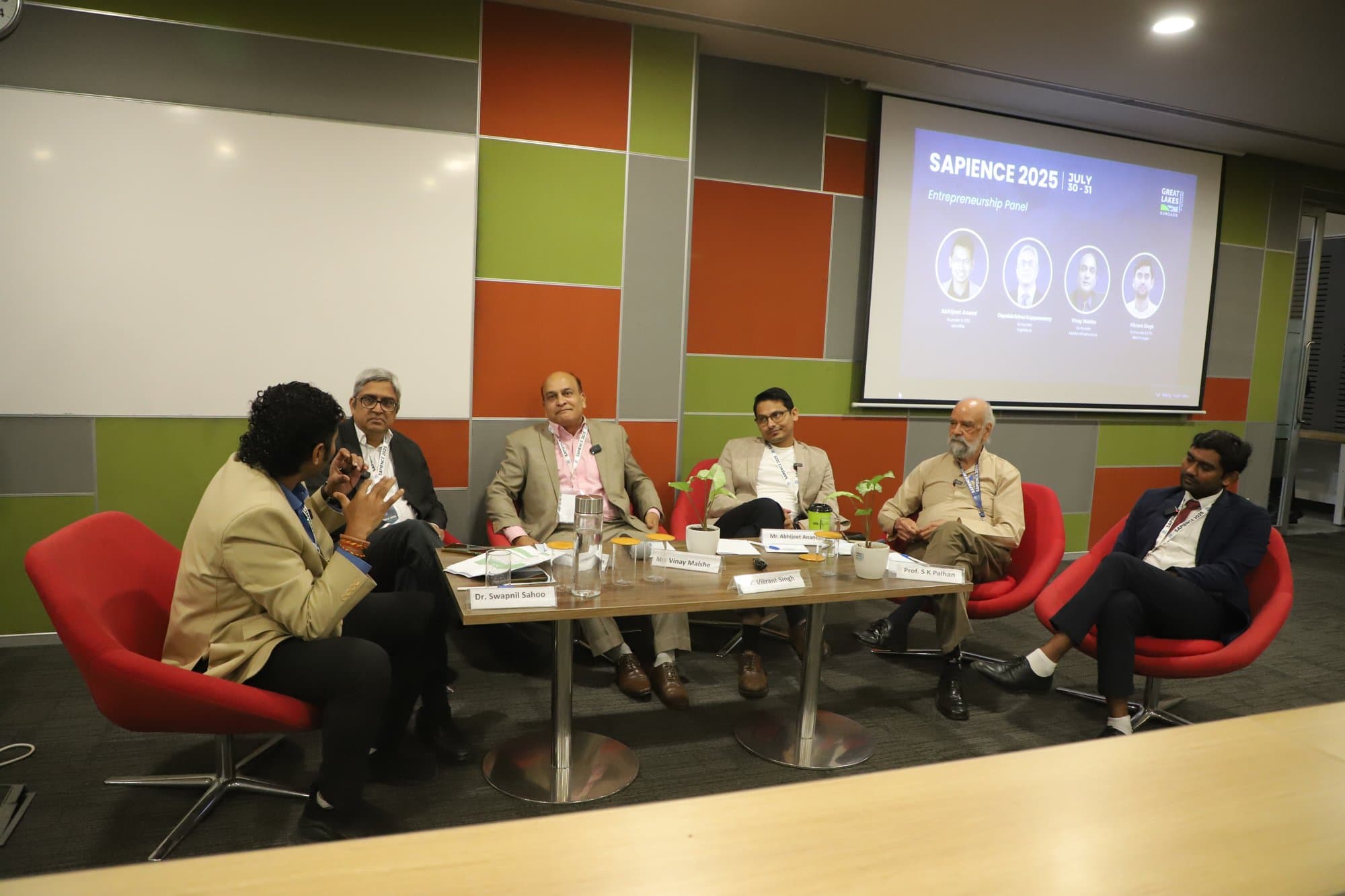
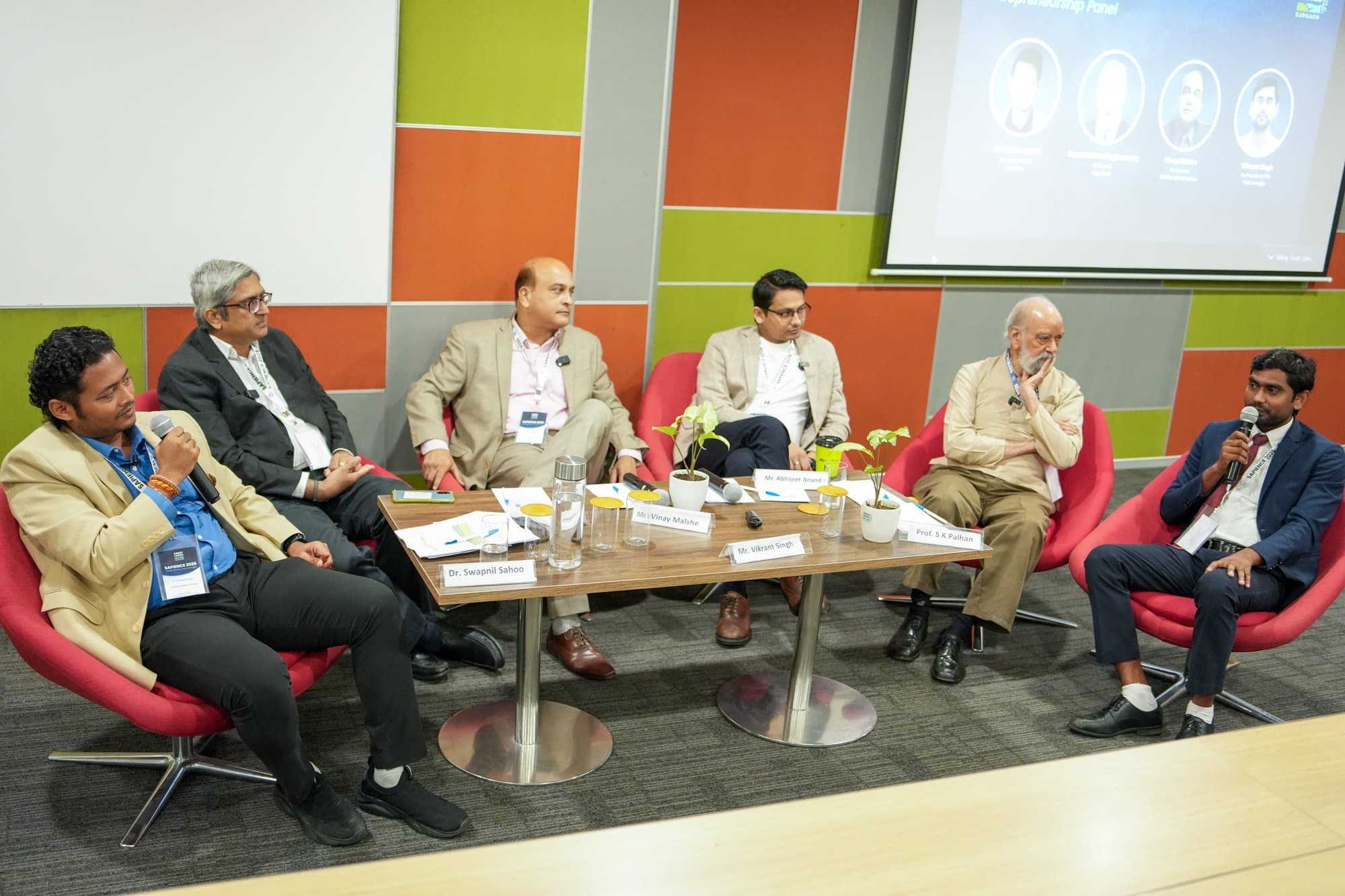
Entrepreneurship Panel · SAPIENCE 2025
Speaking on an Entrepreneurship Panel at SAPIENCE 2025, Great Lakes Gurgaon, 30–31 July.
Mid-panel · SAPIENCE 2025
Making a point during the Entrepreneurship Panel discussion.
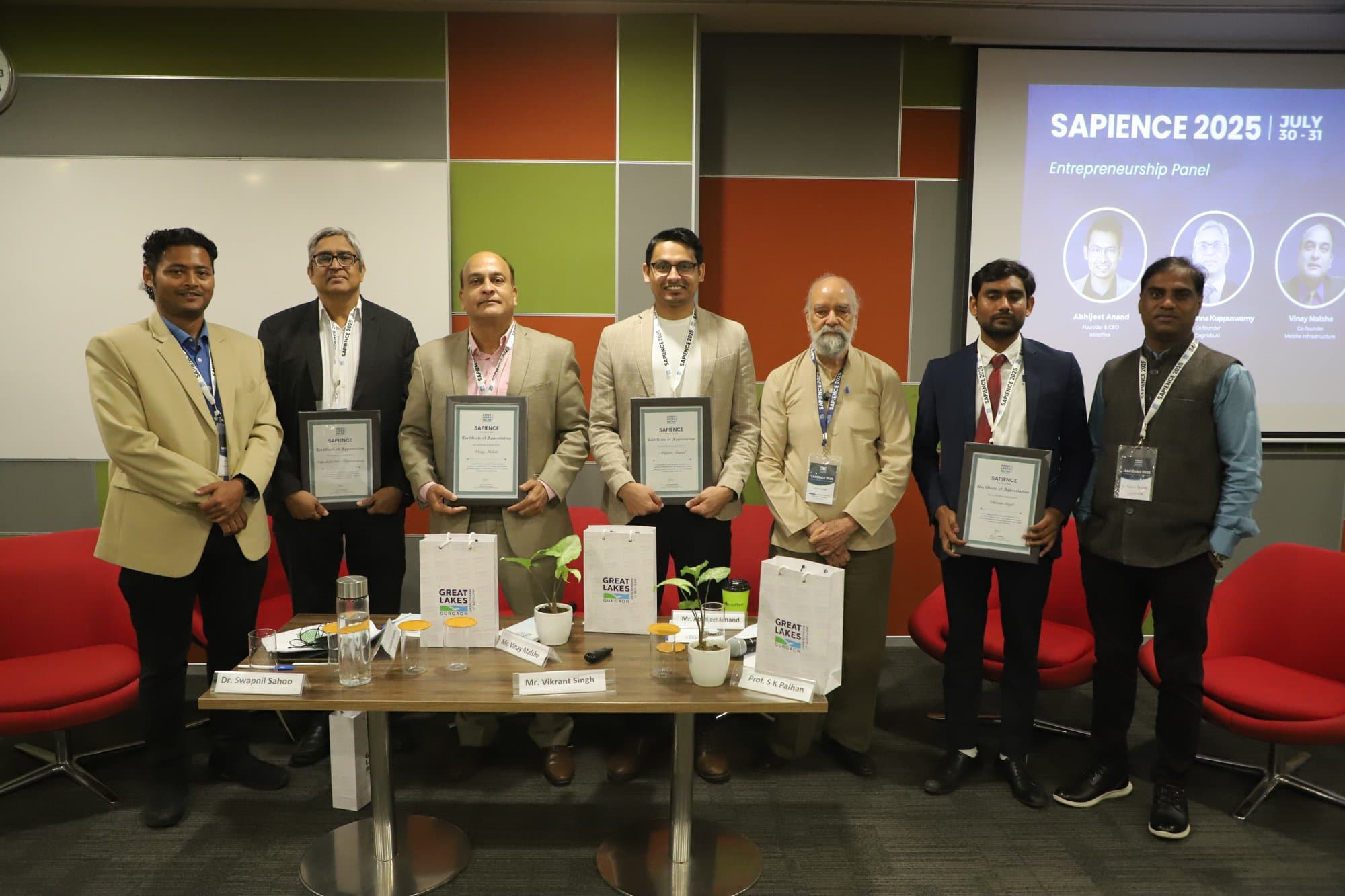
After the panel · SAPIENCE 2025
With fellow panelists and organizers at the close of the session.
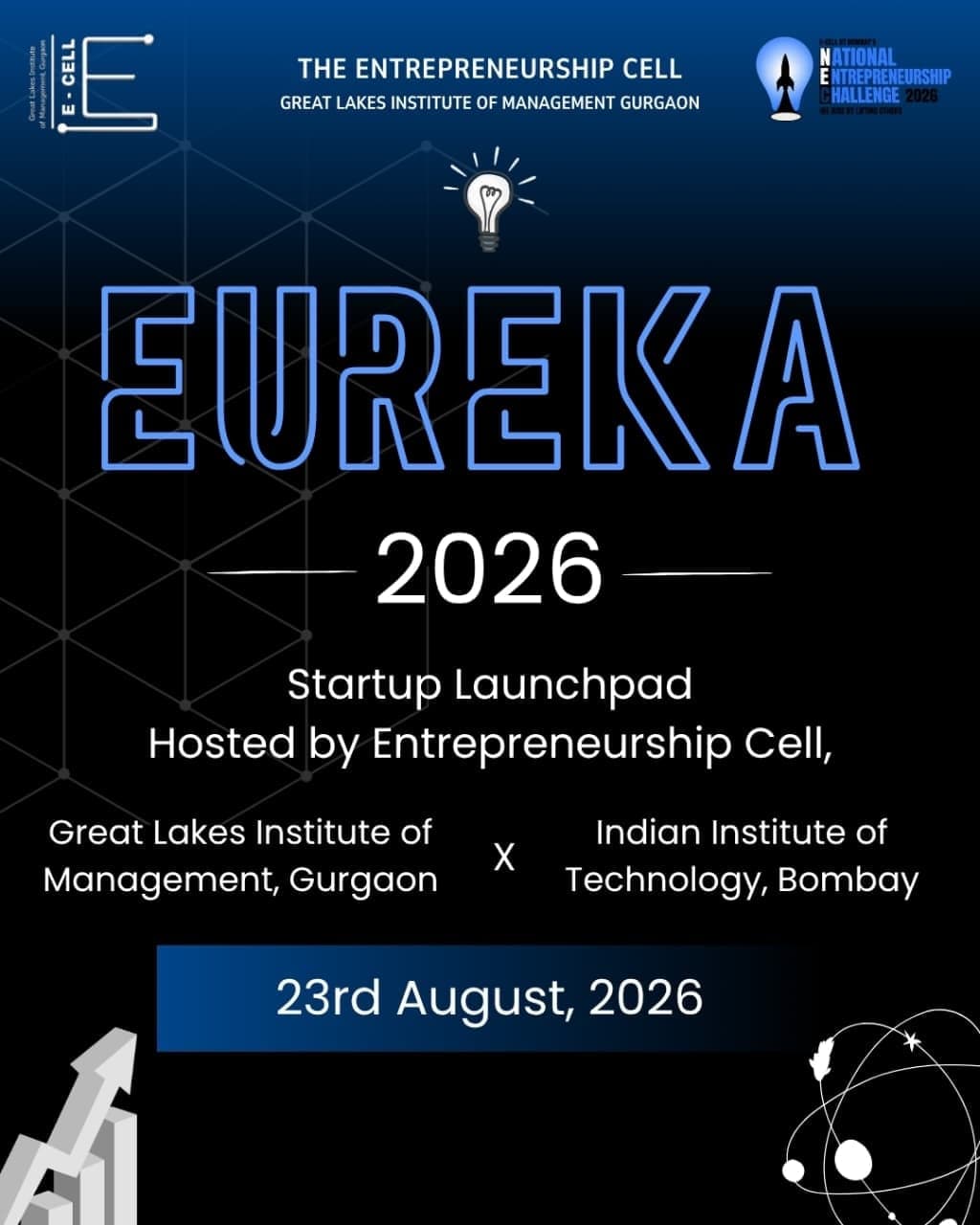
EUREKA 2026 · Startup Launchpad
The official poster for EUREKA 2026 — a Startup Launchpad hosted by the Entrepreneurship Cell at Great Lakes Gurgaon together with the E-Cell of IIT Bombay's National Entrepreneurship Challenge, 23 August. I coordinated the event on behalf of Great Lakes, sat on the jury panel and mentored the organizing team.
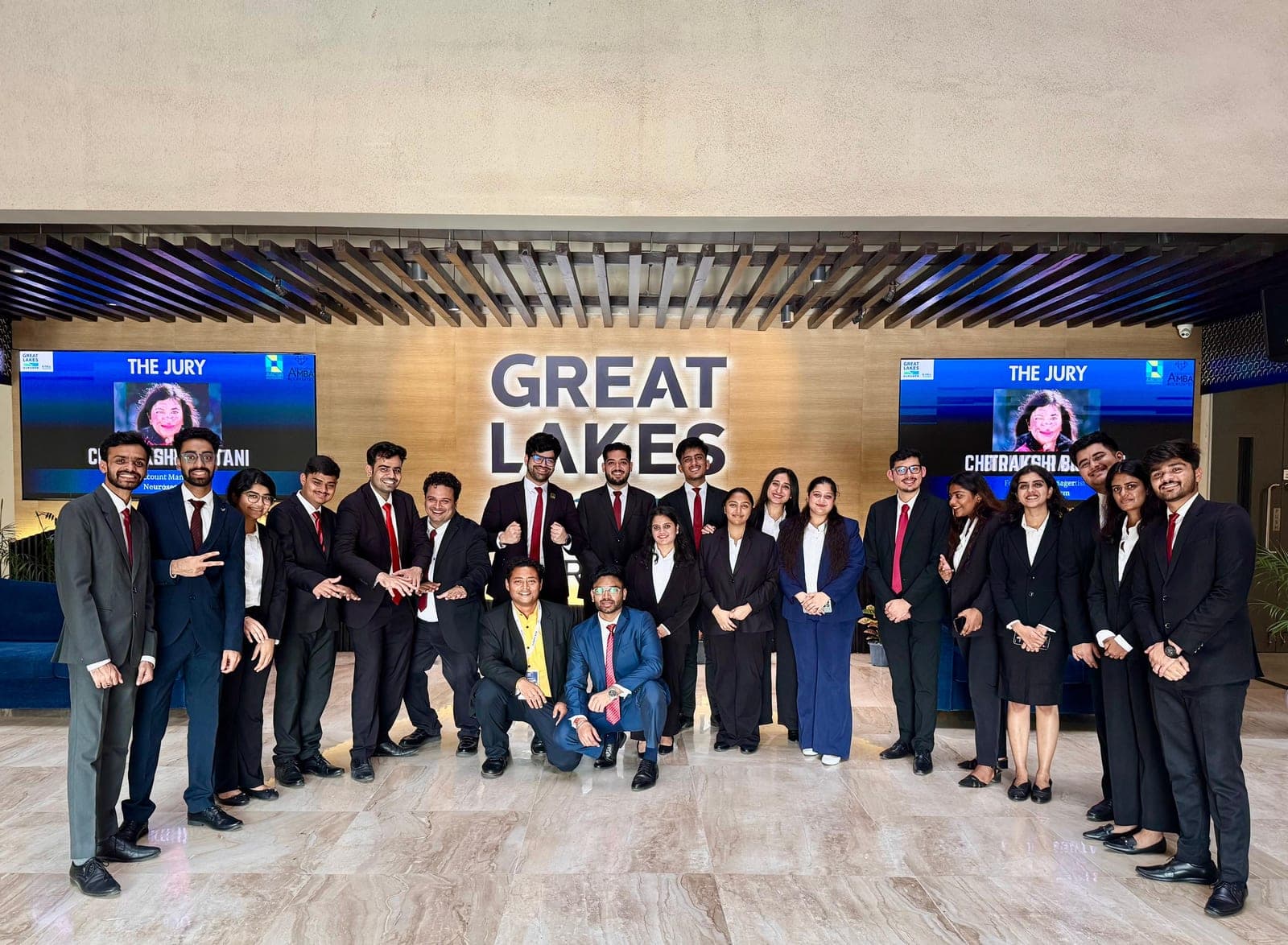
Before the pitches · EUREKA 2026
The Great Lakes Gurgaon organizing team ahead of the pitches, with the jury panel introduced on the screens behind them.
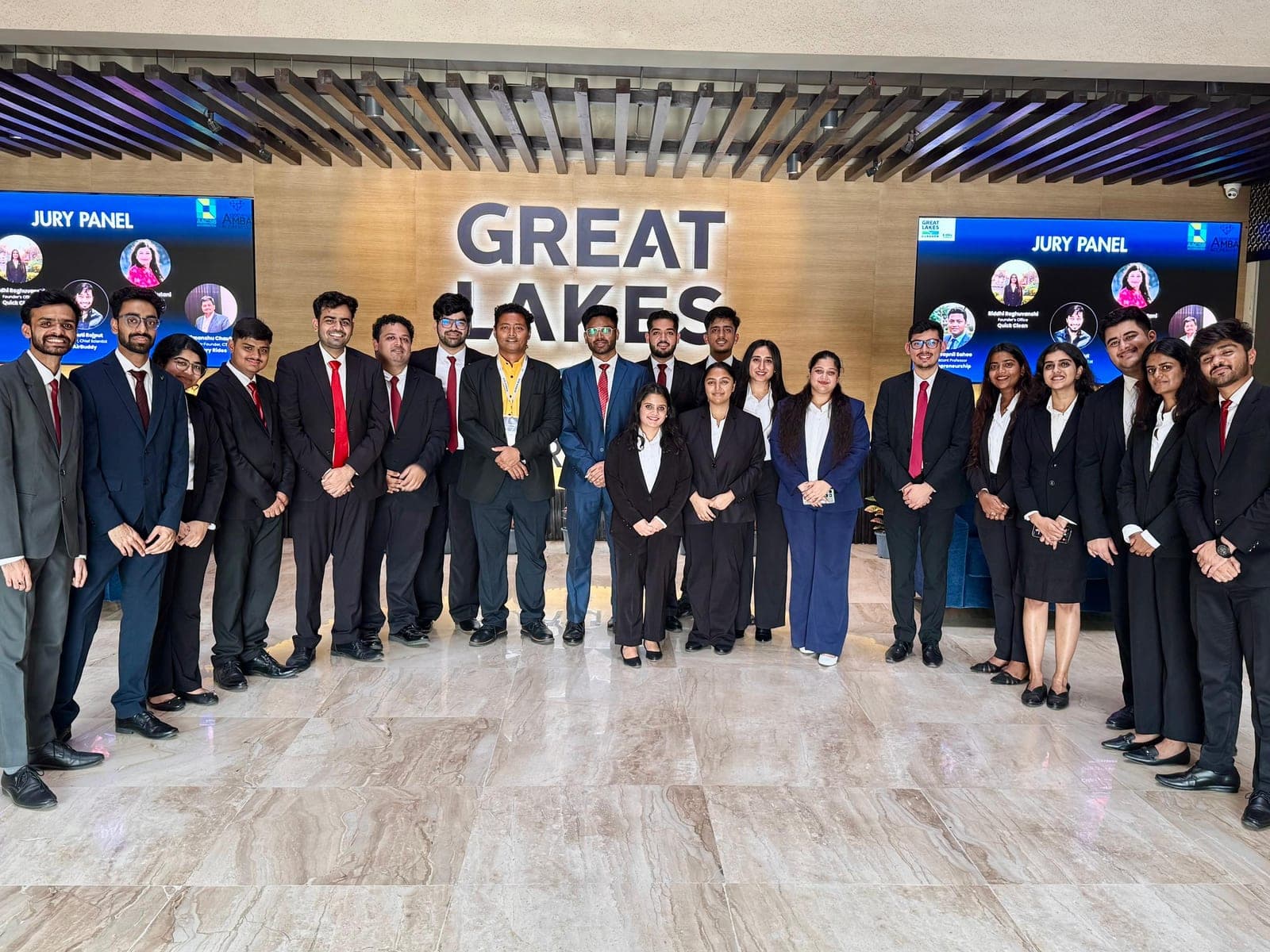
The organizing team · EUREKA 2026
Another moment with the organizing team, moments before EUREKA 2026's pitching round began.
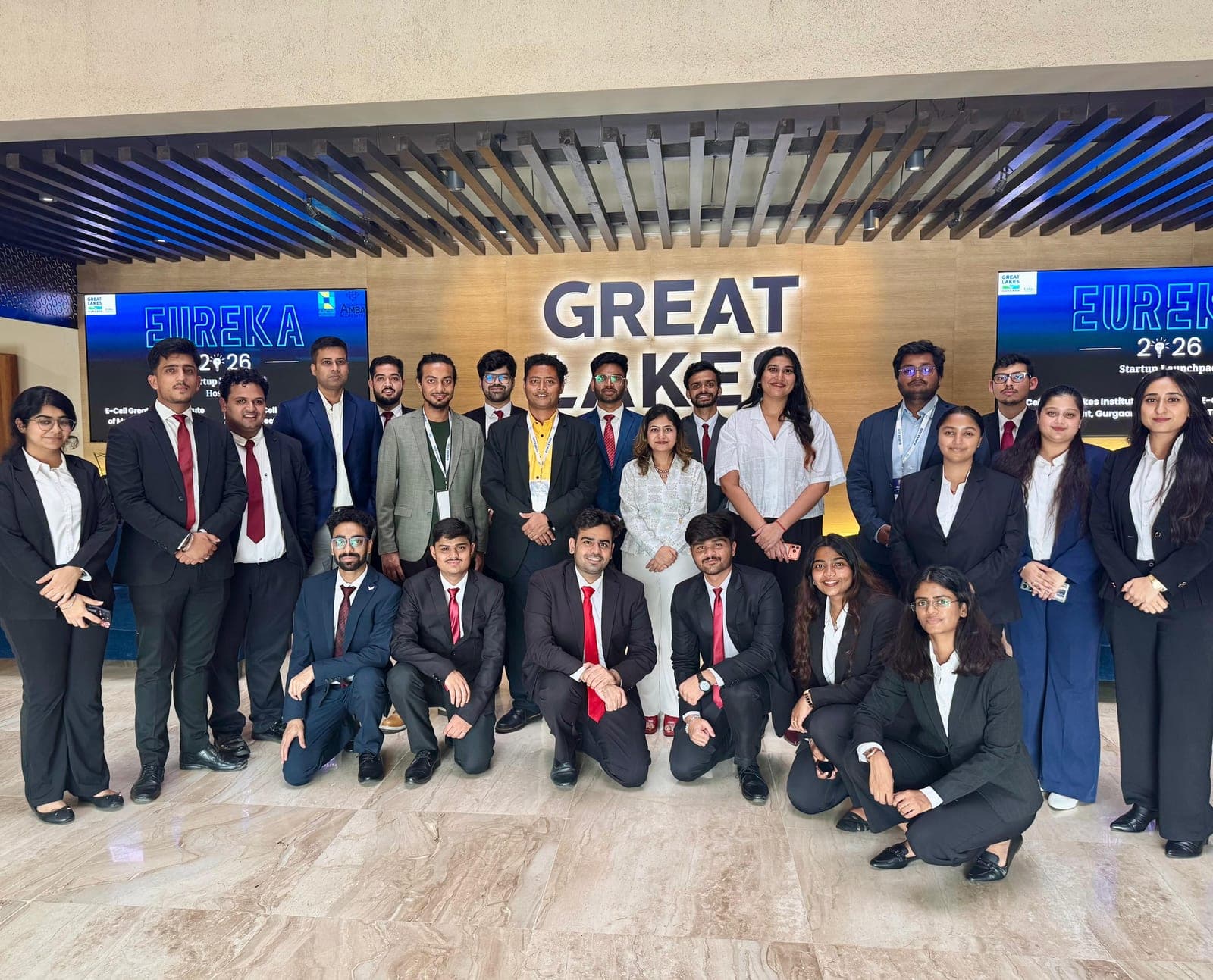
The full team · EUREKA 2026
Students, faculty and the visiting E-Cell IIT Bombay team who together made EUREKA 2026 happen.
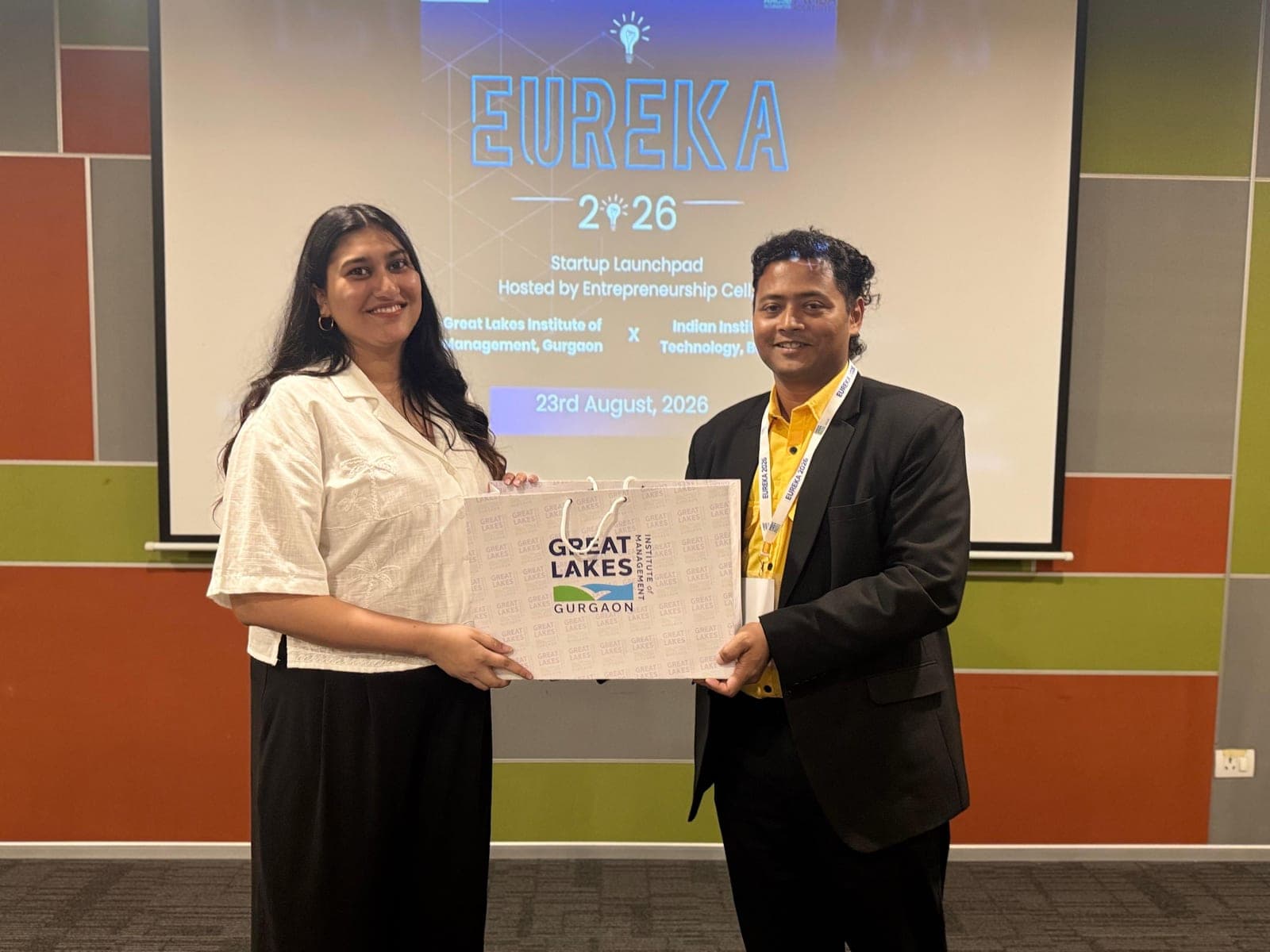
A token of thanks · EUREKA 2026
Presenting a Great Lakes memento to a partner-institution guest at the close of EUREKA 2026.
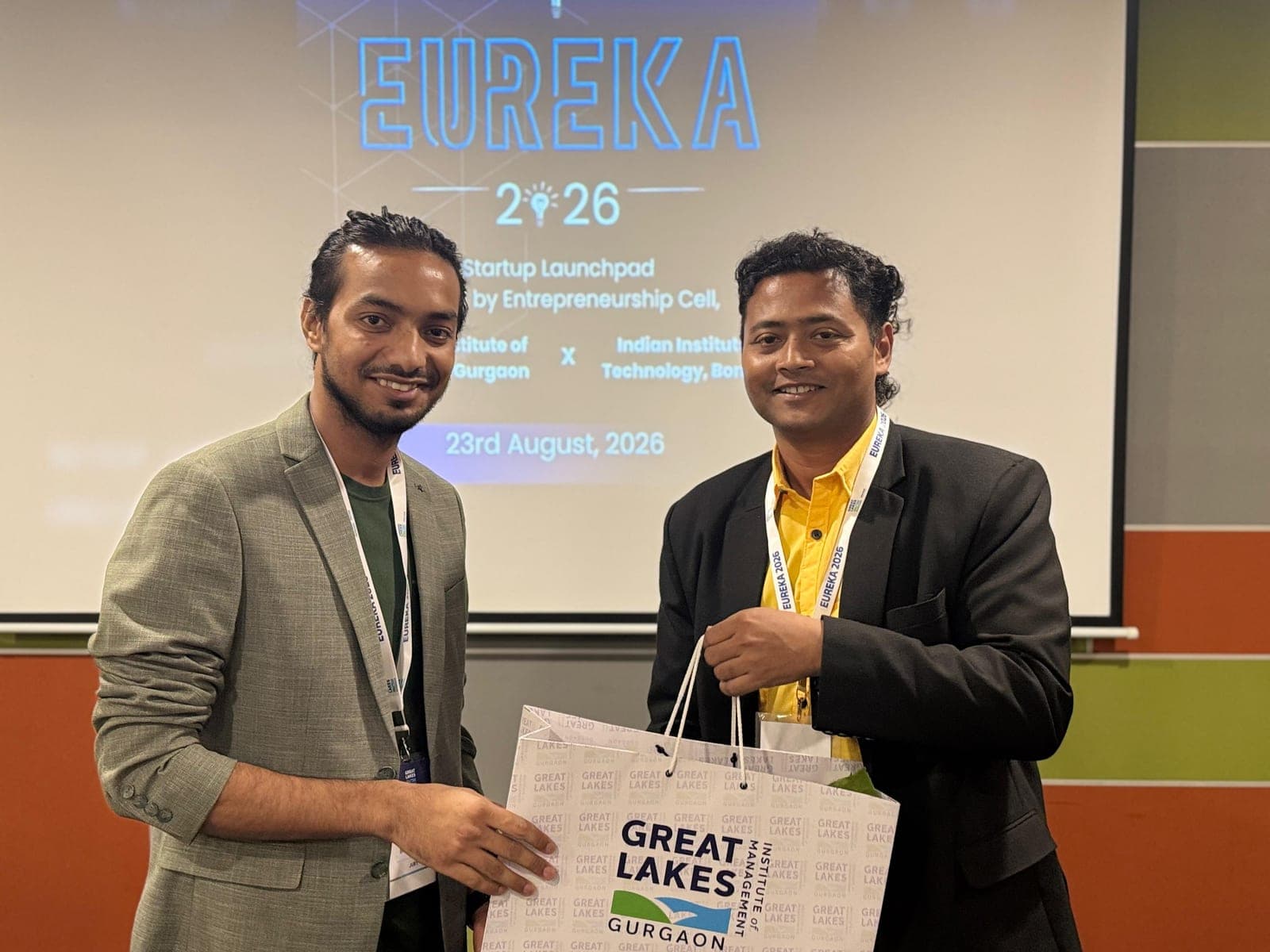
With the organizing team · EUREKA 2026
With a fellow organizer after EUREKA 2026 wrapped for the day.
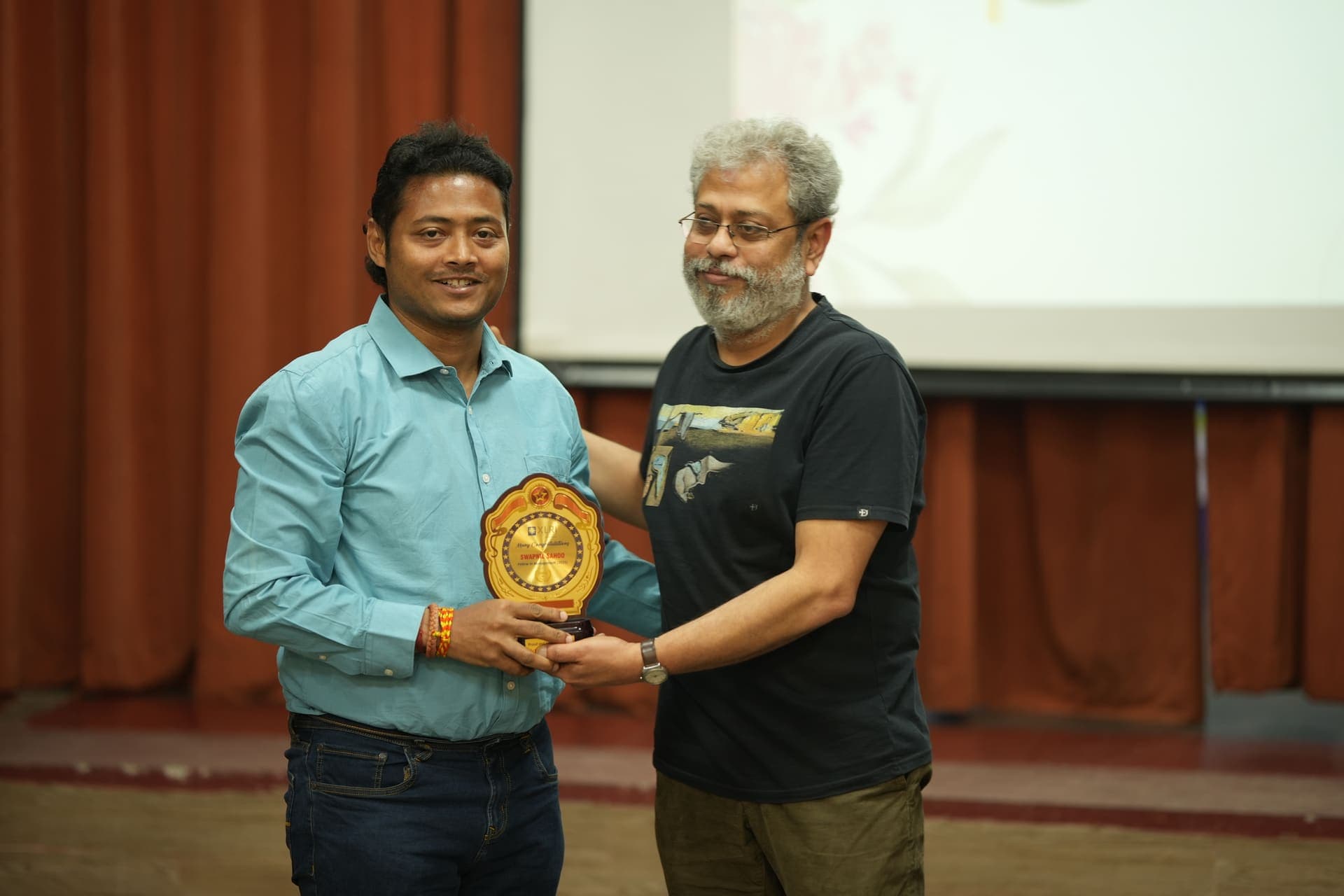
Fellow in Management · XLRI Doctoral Au Revoir 2025
Receiving the memento marking completion of the Fellow Programme in Management, at XLRI Jamshedpur's 2025 doctoral farewell.
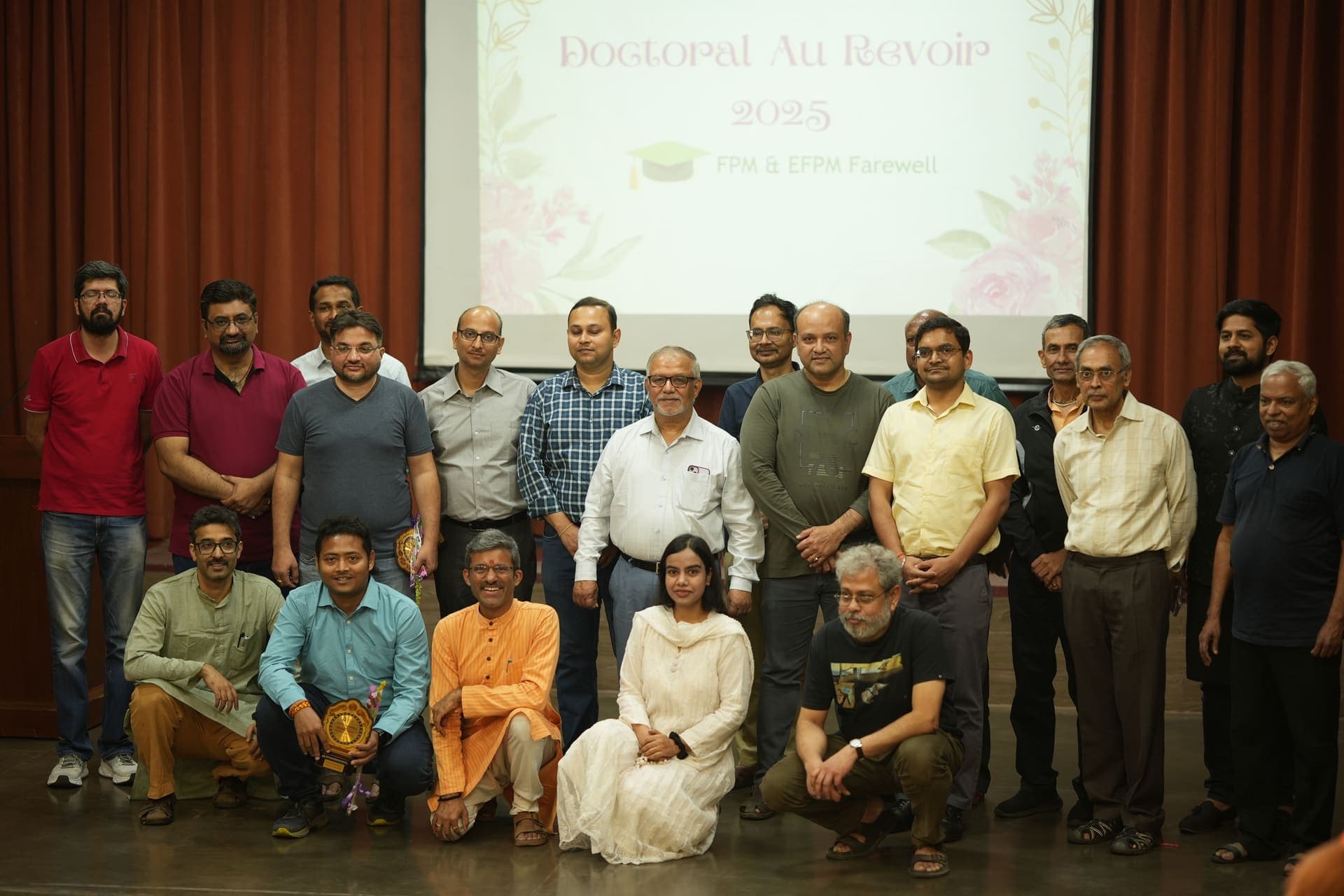
The 2025 cohort · XLRI Doctoral Au Revoir
The FPM and EFPM farewell cohort of 2025, together on stage at XLRI Jamshedpur.
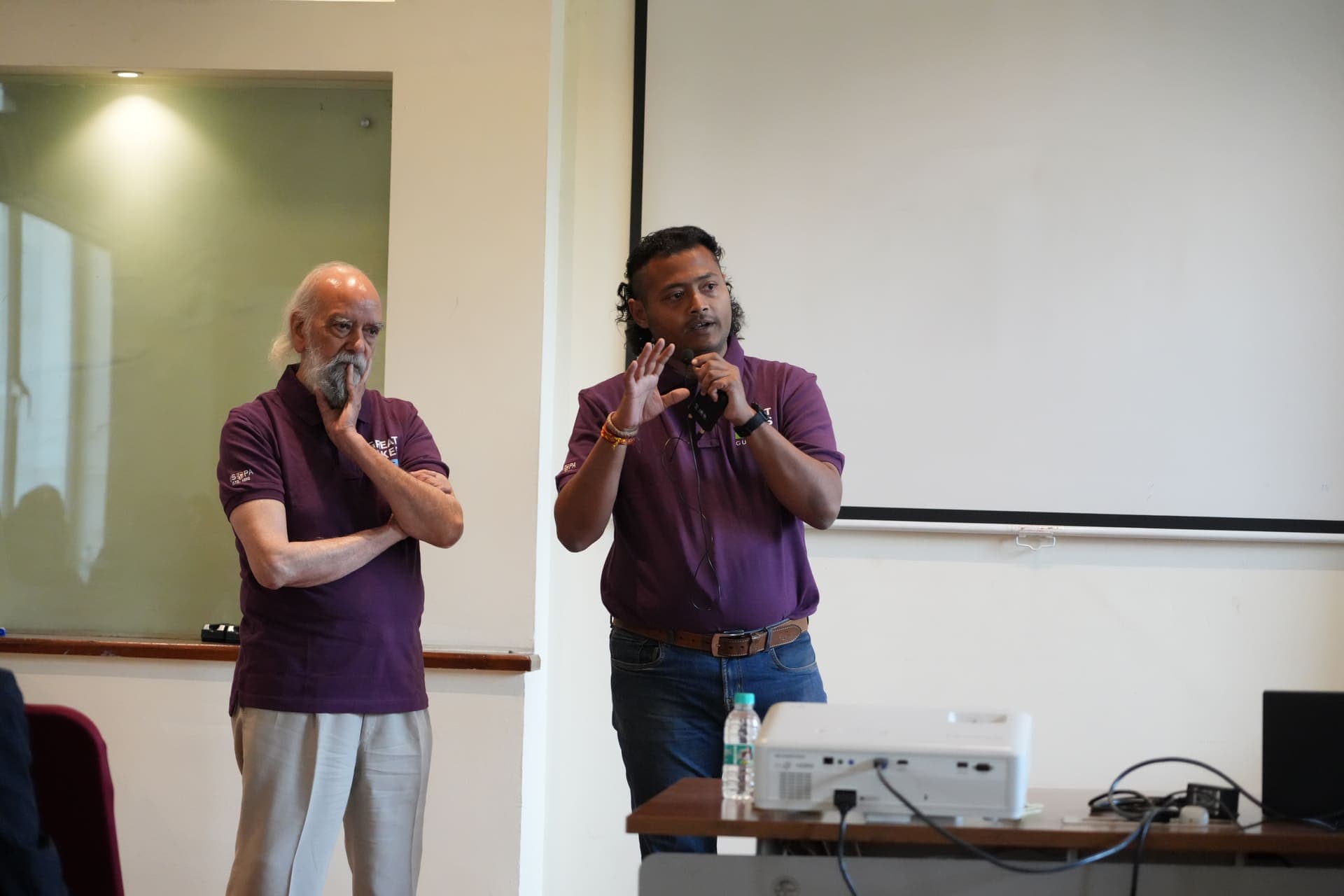
In a faculty workshop · Great Lakes Gurgaon
Working through a session with a colleague during a faculty workshop on campus.
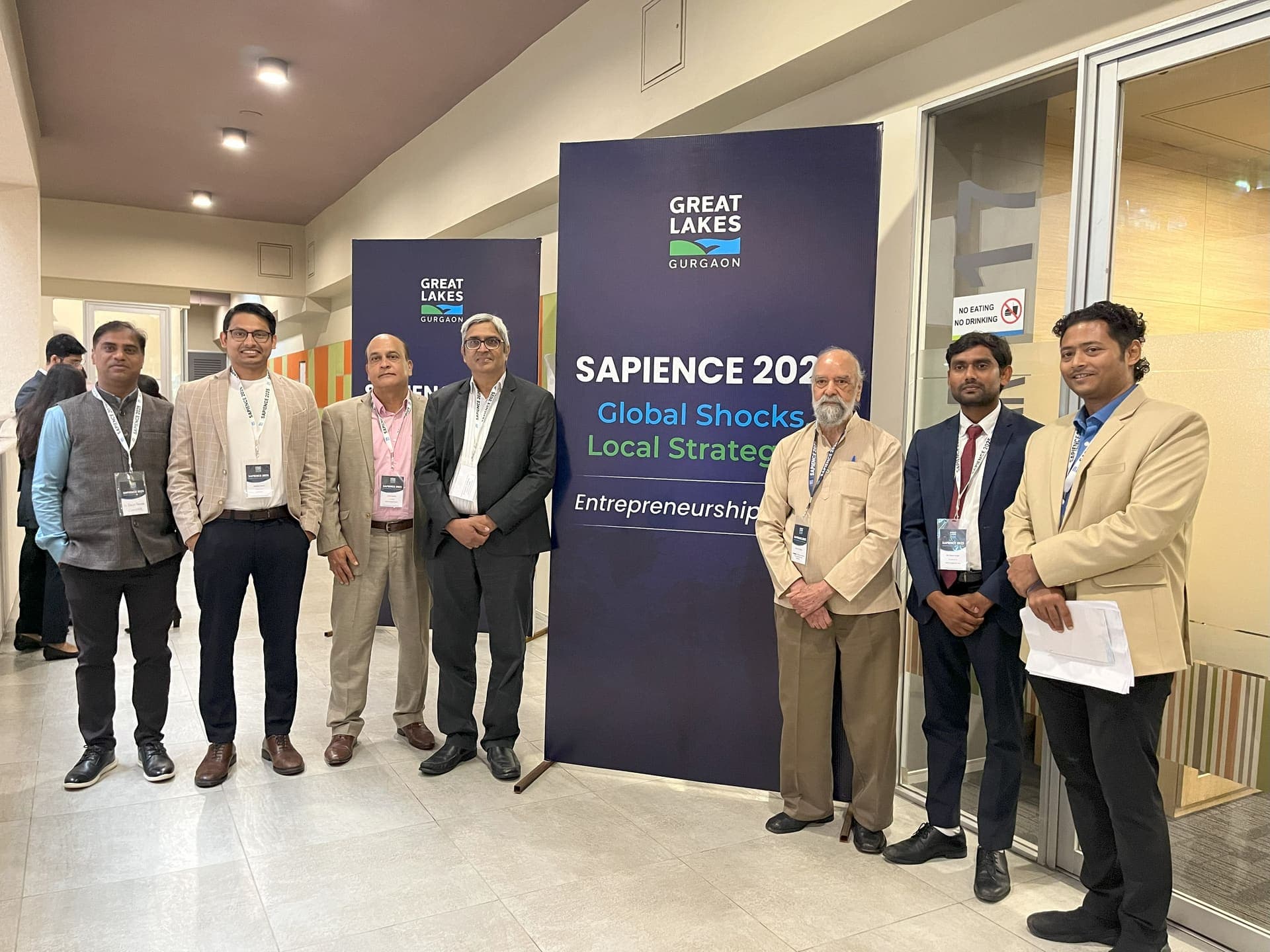
Before the session · SAPIENCE 2025
With fellow speakers ahead of SAPIENCE 2025, Great Lakes Gurgaon's conference on entrepreneurship under global shocks and local strategies.
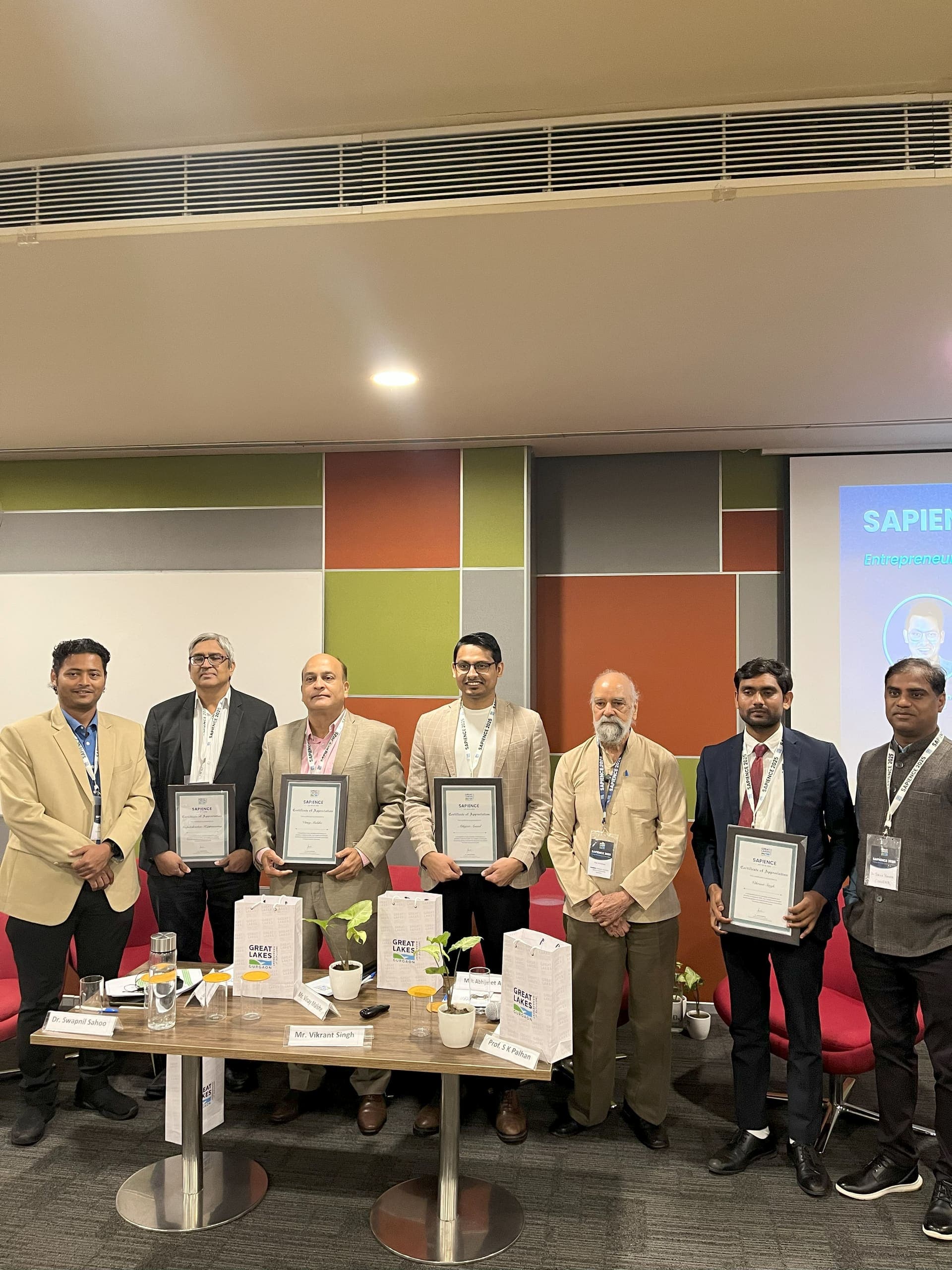
Certificates of appreciation · SAPIENCE 2025
The panel together after SAPIENCE 2025, each holding a certificate of appreciation for the session.
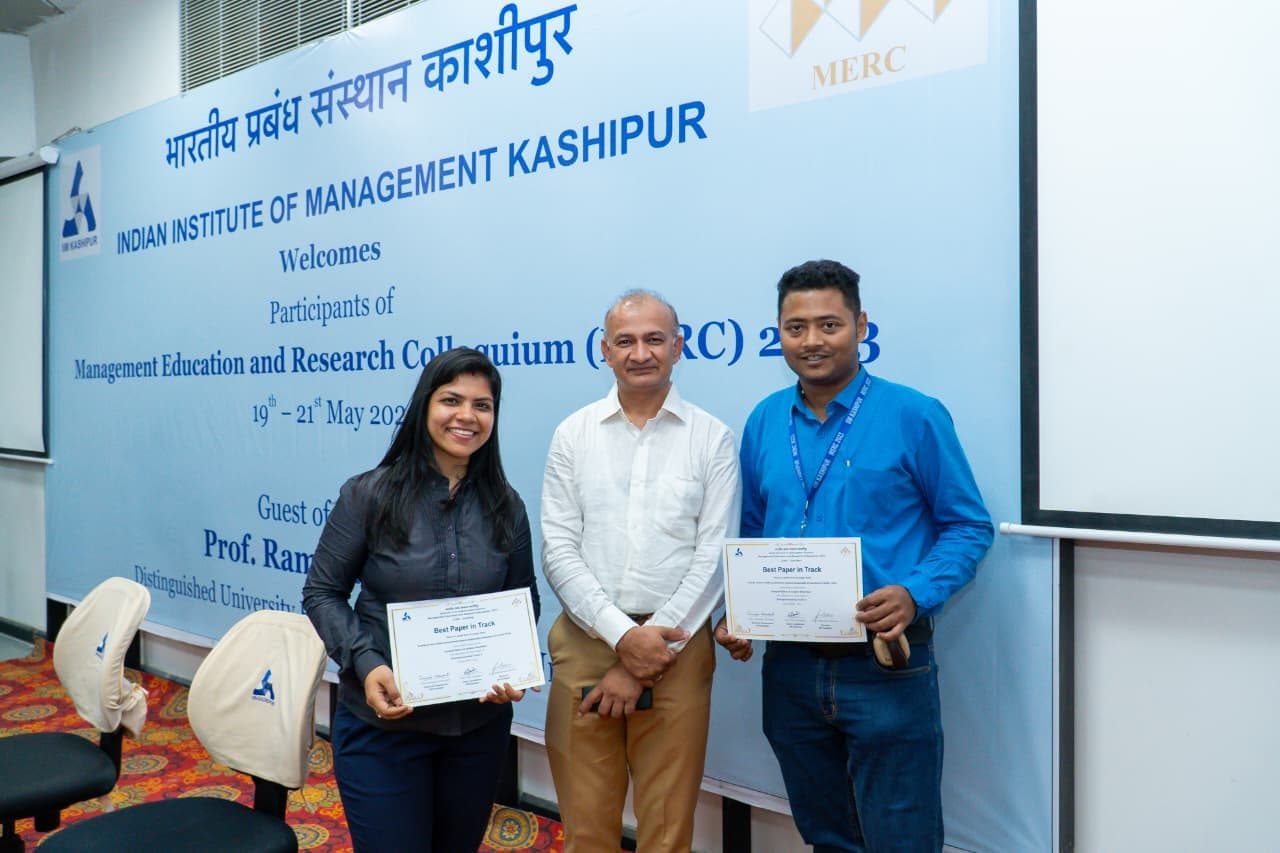
Best Paper in Track · MERC 2023, IIM Kashipur
With co-author Anjana Dharmani, receiving the Best Paper award in the Entrepreneurship Track for “A Study of How Family Involvement Impacts Sustainable Innovation in Family Firms,” at the Management Education and Research Colloquium, IIM Kashipur.
10 / Get in touch
Start with a specific question.
For PhD work, begin with the research puzzle and a one-page concept note. For an executive programme, describe the participants and the decisions they need to work through. You can also write with a speaking invitation or a relevant idea. I read my own email.
swapnil.s@greatlakes.edu.in
Book a 1:1 mentoring slot
A focused conversation about a career decision, research idea or strategic question.
Subscribe to the newsletter
My notes on AI safety, security and academic life, published on Substack.
Official faculty page
Great Lakes Institute of Management, Gurgaon.