Textual home
01Tulsidas's Rāmacaritamānasa
Composed in Awadhi, traditionally dated to 1574–1577 CE, structured in seven kāṇḍas following the arc of Vālmīki's Sanskrit Rāmāyaṇa while remaining an independent devotional retelling.
श्रीरामचरितमानस
Śrī Rāmacaritamānasa
Read from Bālakāṇḍa through Uttarakāṇḍa: all 1,074 numbered units in the pinned seven-kāṇḍa dataset and all 39 opening Sanskrit and Awadhi invocations, each paired with deterministic romanization, an independently prepared close English rendering, and a contextual gloss for every exact source token.
राम
On-site scope
1,113 records · 107,658 contextual token glosses
Awadhi, with Sanskrit invocations · Devanagari + romanization
Seven kāṇḍas · 1,074 numbered units + 39 opening invocations
Before opening the reader
With Śiva telling Pārvatī, Yājñavalkya retelling it, and Tulsidas retelling that — who's actually speaking in any one verse?
Can a source-text edition be complete while its translation and grammar remain honestly unpublished?
01 / Authenticity ledger
Source disclosed. Language named. Attribution qualified. Editorial choices made visible. It does not mean that one modern web page has erased every living recension or interpretive tradition.
Textual home
01Composed in Awadhi, traditionally dated to 1574–1577 CE, structured in seven kāṇḍas following the arc of Vālmīki's Sanskrit Rāmāyaṇa while remaining an independent devotional retelling.
Language
02The narrative verses (dohā, sorathā, caupāī, chhand) are Awadhi; each kāṇḍa opens with Sanskrit invocatory ślokas in the classical style, both preserved here in their own register.
Declared coverage
03The reader preserves the full 1,074-unit sequence of the pinned dataset, restores 39 opening invocations from the public-domain edition, and binds every English study row to the exact source token it explains. Stable IDs follow source order rather than the dataset's lossy decimal locator field.
Traditional attribution
04Devotional and literary tradition is consistent in attributing the whole work to Tulsidas; exact biographical dates rest on tradition rather than independently documented record, as with the Hanuman Chalisa also attributed to him.
02 / Word-by-word reader
Complete selected source + close English word study · 1,113 records
This reader contains 1,074 numbered units in the selected edition's topology plus 39 separately identified opening invocations across all seven kāṇḍas. Unit totals differ between editions, so 1,074 is not presented as a universal verse count. Completeness applies to this declared source topology and its source-token English study coverage; it does not claim a critical edition, Hindi translation, recitation audio, phonetic transcription, or completed grammatical parsing.
Reader controls
Search every layer, narrow the list by section, or switch to the uncluttered line view. Only a small set is rendered at once, so the reader stays quick on phones as well as larger screens.
Showing 12 of 1113 entries
वर्णानामर्थसंघानां रसानां छन्दसामपि । मङ्गलानां च कर्त्तारौ वन्दे वाणीविनायकौ ॥१॥
varṇānāmarthasaṃghānāṃ rasānāṃ chandasāmapi | maṅgalānāṃ ca karttārau vande vāṇīvināyakau ||1||
Close meaning
I revere Vāṇī and Vināyaka, the two makers of phonemes and their gathered meanings, of aesthetic sentiments and even of metres, and of all auspicious beginnings.
Opening invocation transcribed diplomatically from the public-domain 1925 Belvedere Press edition. Edition-specific readings are preserved rather than silently harmonized. The close English rendering and token glosses are an independently prepared editorial layer whose review status is disclosed separately.
Source reference: https://archive.org/details/in.ernet.dli.2015.342236/page/n51/mode/1up · scan page 52
This close rendering and contextual word study are independently prepared working annotations. They are not marked as human-reviewed.
Pinned open source text with the declared scan-verified final Sanskrit correction, plus the public-domain 1925 Belvedere Press opening invocations; IITK Manas Supersite used only as a comparison witness · Belvedere Press 1925 facsimile, scan page 52
These contextual glosses and close renderings were prepared specifically for this edition. They are working editorial translations awaiting independent Awadhi and Sanskrit review, not quotations from IITK or a modern published translation. Original close English rendering from the pinned Devanagari witness; editorial work awaiting independent review.
Open the comparison witness (opens in a new tab)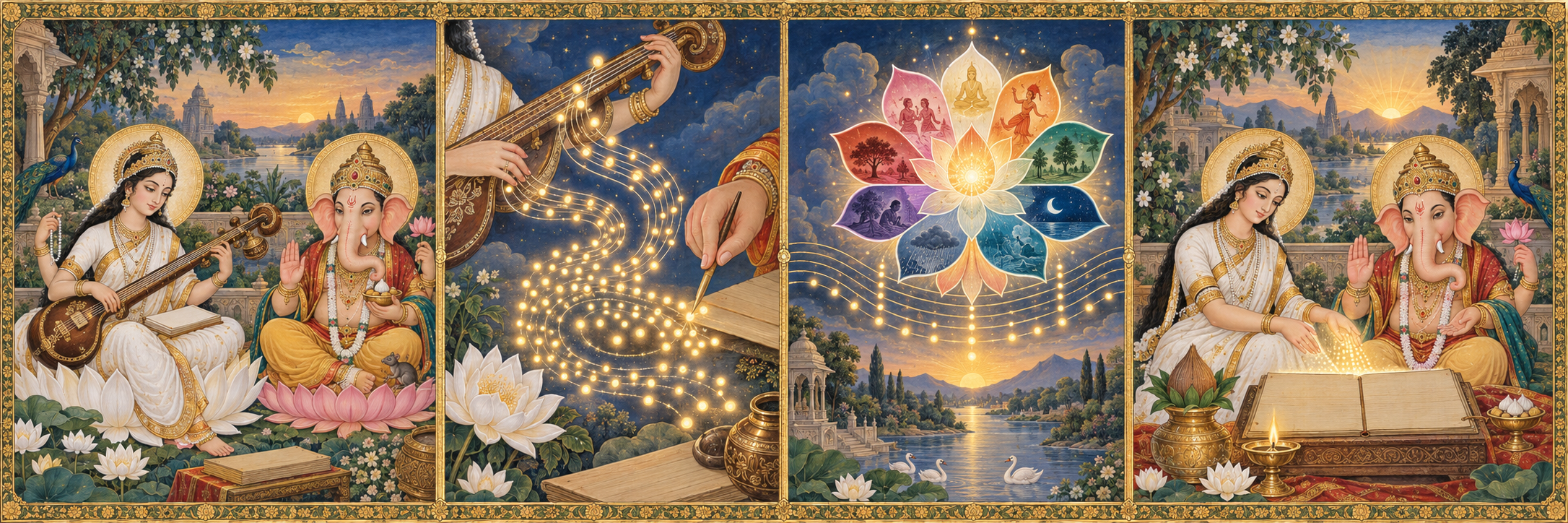
A symbolic visual reading of the opening invocation to Vani and Vinayaka as makers of sounds, gathered meanings, poetic sentiments, metres, and auspicious beginnings.
AI-assisted interpretive artwork · editorial-under-review. It is a reading companion, not part of Tulsidas's text or evidence for a particular historical appearance.
Word & compound study
Source line 01
of phonemes and their gathered meanings
of aesthetic sentiments
and even of metres
Source line 02
of auspicious things and beginnings
and
the two makers
I revere
Vāṇī and Vināyaka
भवानीशङ्करौ वन्दे श्रद्धाविश्वासरूपिणौ । याभ्यां विना न पश्यन्ति सिद्धाः स्वान्तःस्थमीश्वरम् ॥२॥
bhavānīśaṅkarau vande śraddhāviśvāsarūpiṇau | yābhyāṃ vinā na paśyanti siddhāḥ svāntaḥsthamīśvaram ||2||
Close meaning
I revere Bhavānī and Śaṅkara, embodiments of faith and trust; without those two, even the accomplished do not behold the Lord dwelling within their own hearts.
Opening invocation transcribed diplomatically from the public-domain 1925 Belvedere Press edition. Edition-specific readings are preserved rather than silently harmonized. The close English rendering and token glosses are an independently prepared editorial layer whose review status is disclosed separately.
Source reference: https://archive.org/details/in.ernet.dli.2015.342236/page/n51/mode/1up · scan page 52
This close rendering and contextual word study are independently prepared working annotations. They are not marked as human-reviewed.
Pinned open source text with the declared scan-verified final Sanskrit correction, plus the public-domain 1925 Belvedere Press opening invocations; IITK Manas Supersite used only as a comparison witness · Belvedere Press 1925 facsimile, scan page 52
These contextual glosses and close renderings were prepared specifically for this edition. They are working editorial translations awaiting independent Awadhi and Sanskrit review, not quotations from IITK or a modern published translation. Original close English rendering from the pinned Devanagari witness; editorial work awaiting independent review.
Open the comparison witness (opens in a new tab)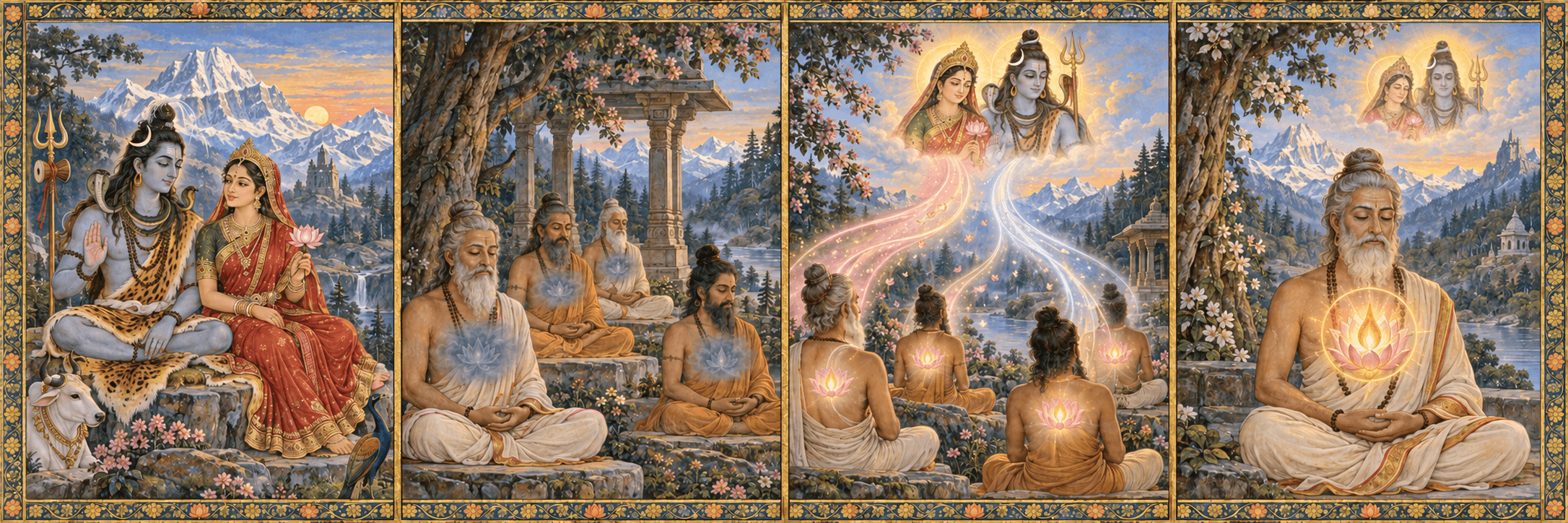
A symbolic visual reading of Bhavani and Shankara as faith and trust, through whom even accomplished contemplatives perceive the indwelling Lord.
AI-assisted interpretive artwork · editorial-under-review. It is a reading companion, not part of Tulsidas's text or evidence for a particular historical appearance.
Word & compound study
Source line 01
Bhavānī and Śaṅkara
I revere
the two who embody faith and trust
Source line 02
without whom two
without
not
behold
the accomplished ones
the Lord abiding within their own hearts
वन्दे बोधमयं नित्यं गुरुं शङ्कररूपिणम् । यमाश्रितो हि वक्रोऽपि चन्द्रः सर्वत्र वन्द्यते ॥३॥
vande bodhamayaṃ nityaṃ guruṃ śaṅkararūpiṇam | yamāśrito hi vakro'pi candraḥ sarvatra vandyate ||3||
Close meaning
I perpetually revere the guru, filled with awakening and bearing Śaṅkara's form; sheltered by him, even the crooked moon is honoured everywhere.
Opening invocation transcribed diplomatically from the public-domain 1925 Belvedere Press edition. Edition-specific readings are preserved rather than silently harmonized. The close English rendering and token glosses are an independently prepared editorial layer whose review status is disclosed separately.
Source reference: https://archive.org/details/in.ernet.dli.2015.342236/page/n51/mode/1up · scan page 52
This close rendering and contextual word study are independently prepared working annotations. They are not marked as human-reviewed.
Pinned open source text with the declared scan-verified final Sanskrit correction, plus the public-domain 1925 Belvedere Press opening invocations; IITK Manas Supersite used only as a comparison witness · Belvedere Press 1925 facsimile, scan page 52
These contextual glosses and close renderings were prepared specifically for this edition. They are working editorial translations awaiting independent Awadhi and Sanskrit review, not quotations from IITK or a modern published translation. Original close English rendering from the pinned Devanagari witness; editorial work awaiting independent review.
Open the comparison witness (opens in a new tab)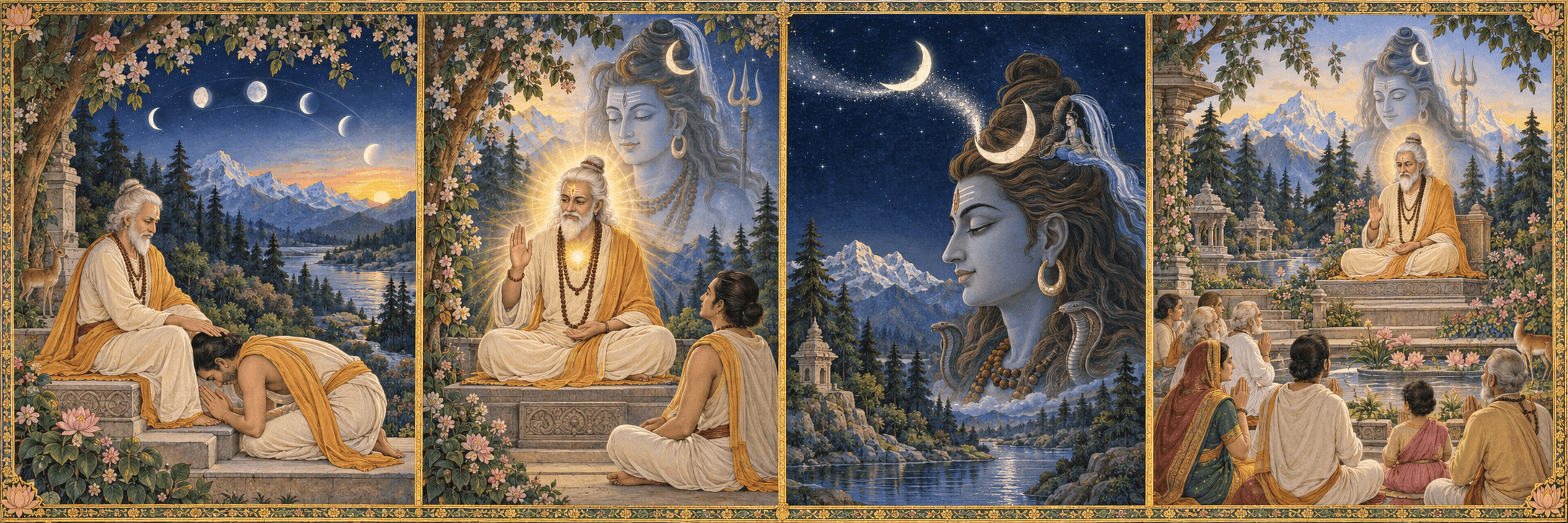
A symbolic visual reading of the guru as Shiva's compassionate presence and of the crescent moon—though naturally crooked—receiving universal reverence because it rests upon Shiva's head.
AI-assisted interpretive artwork · editorial-under-review. It is a reading companion, not part of Tulsidas's text or evidence for a particular historical appearance.
Word & compound study
Source line 01
I revere
filled with awakening
perpetually
the guru
bearing Śaṅkara's form
Source line 02
sheltered by whom
indeed
even though crooked
the moon
everywhere
is honoured
सीतारामगुणग्रामपुण्यारण्यविहारिणौ । वन्दे विशुद्धविज्ञानौ कवीश्वरकपीश्वरौ ॥४॥
sītārāmaguṇagrāmapuṇyāraṇyavihāriṇau | vande viśuddhavijñānau kavīśvarakapīśvarau ||4||
Close meaning
I revere the lord of poets and the lord of monkeys—Vālmīki and Hanumān—whose insight is wholly pure and who roam the sacred forest formed by the host of Sītā and Rāma's virtues.
Opening invocation transcribed diplomatically from the public-domain 1925 Belvedere Press edition. Edition-specific readings are preserved rather than silently harmonized. The close English rendering and token glosses are an independently prepared editorial layer whose review status is disclosed separately.
Source reference: https://archive.org/details/in.ernet.dli.2015.342236/page/n52/mode/1up · scan page 53
This close rendering and contextual word study are independently prepared working annotations. They are not marked as human-reviewed.
Pinned open source text with the declared scan-verified final Sanskrit correction, plus the public-domain 1925 Belvedere Press opening invocations; IITK Manas Supersite used only as a comparison witness · Belvedere Press 1925 facsimile, scan page 53
These contextual glosses and close renderings were prepared specifically for this edition. They are working editorial translations awaiting independent Awadhi and Sanskrit review, not quotations from IITK or a modern published translation. Original close English rendering from the pinned Devanagari witness; editorial work awaiting independent review.
Open the comparison witness (opens in a new tab)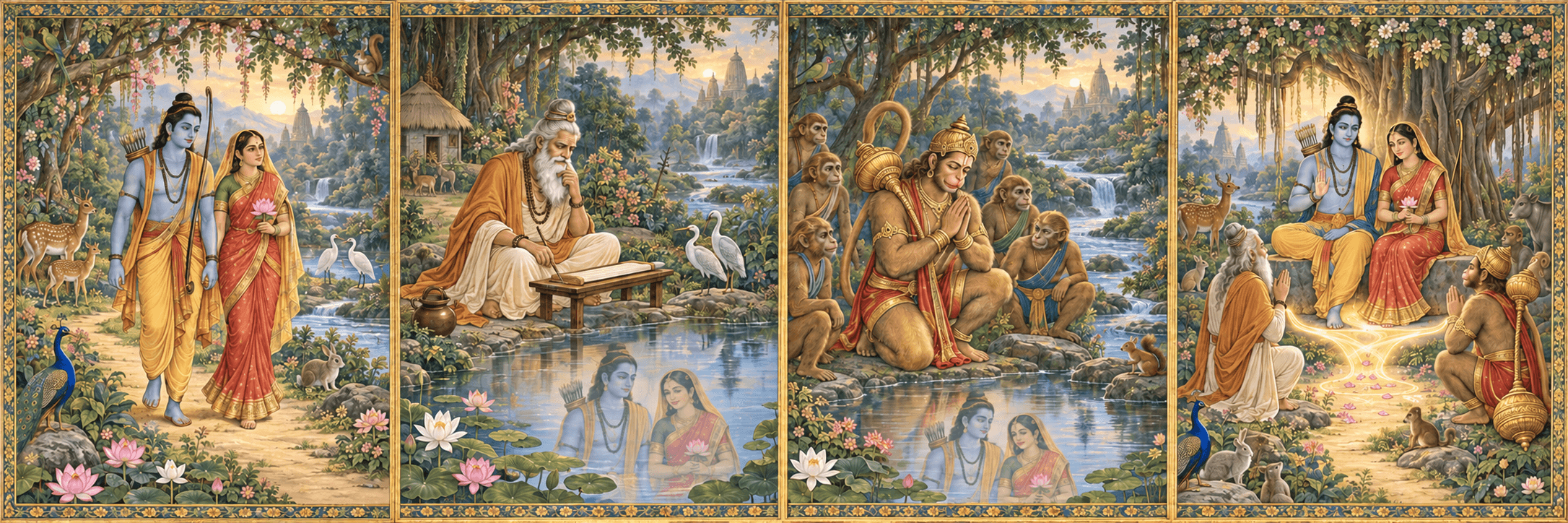
A symbolic visual reading of Valmiki and Hanuman—lords of poets and vanara hosts—moving with purified insight through the sacred forest formed by the abundant virtues of Sita and Rama.
AI-assisted interpretive artwork · editorial-under-review. It is a reading companion, not part of Tulsidas's text or evidence for a particular historical appearance.
Word & compound study
Source line 01
the two who roam the sacred forest of the host of Sītā and Rāma's virtues
Source line 02
I revere
the two of wholly pure insight
the lord of poets and the lord of monkeys
उद्भवस्थितिसंहारकारिणीं क्लेशहारिणीम् । सर्वश्रेयस्करीं सीतां नतोऽहं रामवल्लभाम् ॥५॥
udbhavasthitisaṃhārakāriṇīṃ kleśahāriṇīm | sarvaśreyaskarīṃ sītāṃ nato'haṃ rāmavallabhām ||5||
Close meaning
I bow to Sītā, Rāma's beloved, who brings about creation, continuance and dissolution, removes affliction, and brings every highest good.
Opening invocation transcribed diplomatically from the public-domain 1925 Belvedere Press edition. Edition-specific readings are preserved rather than silently harmonized. The close English rendering and token glosses are an independently prepared editorial layer whose review status is disclosed separately.
Source reference: https://archive.org/details/in.ernet.dli.2015.342236/page/n52/mode/1up · scan page 53
This close rendering and contextual word study are independently prepared working annotations. They are not marked as human-reviewed.
Pinned open source text with the declared scan-verified final Sanskrit correction, plus the public-domain 1925 Belvedere Press opening invocations; IITK Manas Supersite used only as a comparison witness · Belvedere Press 1925 facsimile, scan page 53
These contextual glosses and close renderings were prepared specifically for this edition. They are working editorial translations awaiting independent Awadhi and Sanskrit review, not quotations from IITK or a modern published translation. Original close English rendering from the pinned Devanagari witness; editorial work awaiting independent review.
Open the comparison witness (opens in a new tab)Word & compound study
Source line 01
her who brings about creation, continuance and dissolution
her who removes affliction
Source line 02
her who brings every highest good
Sītā
I bow
Rāma's beloved
यन्मायावशवर्त्ति विश्वमखिलं ब्रह्मादिदेवासुराः । यत्सत्त्वादमृषैव भाति सकलं रज्जौ यथाऽहेर्भ्रमः । यत्पादप्लव एक एव हि भवाम्भोधेस्तितीर्षावताम् । वन्देऽहं तमशेषकारणपरं रामाख्यमीशं हरिम् ॥६॥
yanmāyāvaśavartti viśvamakhilaṃ brahmādidevāsurāḥ | yatsattvādamṛṣaiva bhāti sakalaṃ rajjau yathā'herbhramaḥ | yatpādaplava eka eva hi bhavāmbhodhestitīrṣāvatām | vande'haṃ tamaśeṣakāraṇaparaṃ rāmākhyamīśaṃ harim ||6||
Close meaning
I revere Hari, the sovereign named Rāma, supreme cause of all: the entire universe, including gods beginning with Brahmā and the demons, moves under his māyā; by his reality everything unreal appears real, like the illusion of a snake in a rope; and his foot alone is the boat for those who wish to cross the ocean of becoming.
Opening invocation transcribed diplomatically from the public-domain 1925 Belvedere Press edition. Edition-specific readings are preserved rather than silently harmonized. The close English rendering and token glosses are an independently prepared editorial layer whose review status is disclosed separately.
Source reference: https://archive.org/details/in.ernet.dli.2015.342236/page/n52/mode/1up · scan page 53
This close rendering and contextual word study are independently prepared working annotations. They are not marked as human-reviewed.
Pinned open source text with the declared scan-verified final Sanskrit correction, plus the public-domain 1925 Belvedere Press opening invocations; IITK Manas Supersite used only as a comparison witness · Belvedere Press 1925 facsimile, scan page 53
These contextual glosses and close renderings were prepared specifically for this edition. They are working editorial translations awaiting independent Awadhi and Sanskrit review, not quotations from IITK or a modern published translation. Original close English rendering of the pinned edition-specific reading; editorial work awaiting independent review.
Open the comparison witness (opens in a new tab)Word & compound study
Source line 01
moves under whose māyā
the entire universe
gods beginning with Brahmā and the demons
Source line 02
by whose reality, though itself unreal
appears
everything
in a rope
like the illusion of a snake
Source line 03
whose foot as a boat
alone
indeed
surely
for those wishing to cross the ocean of becoming
Source line 04
I revere
that supreme cause of all
the sovereign named Rāma
Hari
नानापुराणनिगमागमसम्मतं यद्रामायणे निगदितं क्वचिदन्यतोऽपि । स्वान्तःसुखाय तुलसी रघुनाथगाथाभाषानिबन्धमतिमञ्जुलमातनोति ॥७॥
nānāpurāṇanigamāgamasammataṃ yadrāmāyaṇe nigaditaṃ kvacidanyato'pi | svāntaḥsukhāya tulasī raghunāthagāthābhāṣānibandhamatimañjulamātanoti ||7||
Close meaning
For the delight of his own heart, Tulasī unfolds this exceedingly lovely composition in the vernacular on the story of Raghunātha, drawing on what is approved by many Purāṇas, Vedas and Āgamas, what is told in the Rāmāyaṇa, and occasionally what comes from elsewhere.
Opening invocation transcribed diplomatically from the public-domain 1925 Belvedere Press edition. Edition-specific readings are preserved rather than silently harmonized. The close English rendering and token glosses are an independently prepared editorial layer whose review status is disclosed separately.
Source reference: https://archive.org/details/in.ernet.dli.2015.342236/page/n53/mode/1up · scan page 54
This close rendering and contextual word study are independently prepared working annotations. They are not marked as human-reviewed.
Pinned open source text with the declared scan-verified final Sanskrit correction, plus the public-domain 1925 Belvedere Press opening invocations; IITK Manas Supersite used only as a comparison witness · Belvedere Press 1925 facsimile, scan page 54
These contextual glosses and close renderings were prepared specifically for this edition. They are working editorial translations awaiting independent Awadhi and Sanskrit review, not quotations from IITK or a modern published translation. Original close English rendering from the pinned Devanagari witness; editorial work awaiting independent review.
Open the comparison witness (opens in a new tab)Word & compound study
Source line 01
approved by many Purāṇas, Vedas and Āgamas
what in the Rāmāyaṇa
is told
and occasionally from elsewhere
Source line 02
for the delight of his own heart
Tulasī
unfolds an exceedingly lovely vernacular composition on Raghunātha's story
जेहि सुमिरत सिधि होइ, गन-नायक करि-बर-बदन । करउ अनुग्रह सोइ, बुद्धि-रासि सुभ-गुन-सदन ॥
jehi sumirata sidhi hoi, gana-nāyaka kari-bara-badana | karau anugraha soi, buddhi-rāsi subha-guna-sadana ||
Close meaning
May that leader of the hosts, whose face is that of the noblest elephant and by remembering whom accomplishment comes, show me grace—that treasury of wisdom and dwelling-place of auspicious virtues.
Opening invocation transcribed diplomatically from the public-domain 1925 Belvedere Press edition. Edition-specific readings are preserved rather than silently harmonized. The close English rendering and token glosses are an independently prepared editorial layer whose review status is disclosed separately.
Source reference: https://archive.org/details/in.ernet.dli.2015.342236/page/n53/mode/1up · scan page 54
This close rendering and contextual word study are independently prepared working annotations. They are not marked as human-reviewed.
Pinned open source text with the declared scan-verified final Sanskrit correction, plus the public-domain 1925 Belvedere Press opening invocations; IITK Manas Supersite used only as a comparison witness · Belvedere Press 1925 facsimile, scan page 54
These contextual glosses and close renderings were prepared specifically for this edition. They are working editorial translations awaiting independent Awadhi and Sanskrit review, not quotations from IITK or a modern published translation. Original close English rendering of the pinned Awadhi reading; editorial work awaiting independent review.
Open the comparison witness (opens in a new tab)Word & compound study
Source line 01
whom
on remembering
accomplishment
comes to be
of the hosts
leader
elephant
noblest
faced
Source line 02
may he show
grace
that very one
of wisdom
treasury
auspicious
virtues
dwelling-place
मूक होइ बाचाल, पङ्गु चढ़इ गिरिवर गहन । जासु कृपा सो दयाल, द्रवउ सकल-कलिमल-दहन ॥
mūka hoi bācāla, paṅgu caḍha़i girivara gahana | jāsu kṛpā so dayāla, dravau sakala-kalimala-dahana ||
Close meaning
By whose grace the mute becomes eloquent and the lame climbs an inaccessible mountain—may that compassionate one, the burner of every impurity of the Kali age, melt with mercy.
Opening invocation transcribed diplomatically from the public-domain 1925 Belvedere Press edition. Edition-specific readings are preserved rather than silently harmonized. The close English rendering and token glosses are an independently prepared editorial layer whose review status is disclosed separately.
Source reference: https://archive.org/details/in.ernet.dli.2015.342236/page/n53/mode/1up · scan page 54
This close rendering and contextual word study are independently prepared working annotations. They are not marked as human-reviewed.
Pinned open source text with the declared scan-verified final Sanskrit correction, plus the public-domain 1925 Belvedere Press opening invocations; IITK Manas Supersite used only as a comparison witness · Belvedere Press 1925 facsimile, scan page 54
These contextual glosses and close renderings were prepared specifically for this edition. They are working editorial translations awaiting independent Awadhi and Sanskrit review, not quotations from IITK or a modern published translation. Original close English rendering of the pinned Awadhi reading; editorial work awaiting independent review.
Open the comparison witness (opens in a new tab)Word & compound study
Source line 01
the mute
becomes
eloquent
the lame
climbs
a mighty mountain
inaccessible
Source line 02
by whose
grace
that one
compassionate
may he melt with mercy
every
impurity of the Kali age
burner
नील-सरोरुह-स्याम, तरुन-अरुन-बारिज नयन । करउ सो मम उर धाम, सदा छीर-सागर-सयन ॥
nīla-saroruha-syāma, taruna-aruna-bārija nayana | karau so mama ura dhāma, sadā chīra-sāgara-sayana ||
Close meaning
May he who is dark as a blue lotus, whose eyes are like young red lotuses, and who forever reclines upon the Ocean of Milk, make my heart his dwelling.
Opening invocation transcribed diplomatically from the public-domain 1925 Belvedere Press edition. Edition-specific readings are preserved rather than silently harmonized. The close English rendering and token glosses are an independently prepared editorial layer whose review status is disclosed separately.
Source reference: https://archive.org/details/in.ernet.dli.2015.342236/page/n54/mode/1up · scan page 55
This close rendering and contextual word study are independently prepared working annotations. They are not marked as human-reviewed.
Pinned open source text with the declared scan-verified final Sanskrit correction, plus the public-domain 1925 Belvedere Press opening invocations; IITK Manas Supersite used only as a comparison witness · Belvedere Press 1925 facsimile, scan page 54
These contextual glosses and close renderings were prepared specifically for this edition. They are working editorial translations awaiting independent Awadhi and Sanskrit review, not quotations from IITK or a modern published translation. Original close English rendering of the pinned Awadhi reading; editorial work awaiting independent review.
Open the comparison witness (opens in a new tab)Word & compound study
Source line 01
blue
lotus
dark-hued
young
red
lotus
eyed
Source line 02
may he make
that one
my
heart
dwelling
forever
milk
ocean
reclining
कुन्द-इन्दु-सम देह, उमा-रमन करुना-अयन । जाहि दीन पर नेह, करउ कृपा मर्दन-मयन ॥
kunda-indu-sama deha, umā-ramana karunā-ayana | jāhi dīna para neha, karau kṛpā mardana-mayana ||
Close meaning
May Umā's beloved—whose body is like jasmine and the moon, who is the abode of compassion and loves the lowly—show grace, he who crushed the god of love.
Opening invocation transcribed diplomatically from the public-domain 1925 Belvedere Press edition. Edition-specific readings are preserved rather than silently harmonized. The close English rendering and token glosses are an independently prepared editorial layer whose review status is disclosed separately.
Source reference: https://archive.org/details/in.ernet.dli.2015.342236/page/n54/mode/1up · scan page 55
This close rendering and contextual word study are independently prepared working annotations. They are not marked as human-reviewed.
Pinned open source text with the declared scan-verified final Sanskrit correction, plus the public-domain 1925 Belvedere Press opening invocations; IITK Manas Supersite used only as a comparison witness · Belvedere Press 1925 facsimile, scan page 54
These contextual glosses and close renderings were prepared specifically for this edition. They are working editorial translations awaiting independent Awadhi and Sanskrit review, not quotations from IITK or a modern published translation. Original close English rendering of the pinned Awadhi reading; editorial work awaiting independent review.
Open the comparison witness (opens in a new tab)Word & compound study
Source line 01
jasmine
moon
like
bodied
Umā's
beloved
of compassion
abode
Source line 02
who
the lowly
toward
has love
may he show
grace
crusher
of the god of love
बन्दउँ गुरु-पद-कञ्ज, कृपा-सिन्धु नर-रूप-हरि । महामोह-तम-पुञ्ज, जासु बचन-रवि-कर-निकर ॥
bandau~ guru-pada-kañja, kṛpā-sindhu nara-rūpa-hari | mahāmoha-tama-puñja, jāsu bacana-ravi-kara-nikara ||
Close meaning
I bow to the guru's lotus feet—to the ocean of grace, Hari in human form—whose words are a mass of sunbeams that dispels the dense darkness of great delusion.
Opening invocation transcribed diplomatically from the public-domain 1925 Belvedere Press edition. Edition-specific readings are preserved rather than silently harmonized. The close English rendering and token glosses are an independently prepared editorial layer whose review status is disclosed separately.
Source reference: https://archive.org/details/in.ernet.dli.2015.342236/page/n54/mode/1up · scan page 55
This close rendering and contextual word study are independently prepared working annotations. They are not marked as human-reviewed.
Pinned open source text with the declared scan-verified final Sanskrit correction, plus the public-domain 1925 Belvedere Press opening invocations; IITK Manas Supersite used only as a comparison witness · Belvedere Press 1925 facsimile, scan page 54
These contextual glosses and close renderings were prepared specifically for this edition. They are working editorial translations awaiting independent Awadhi and Sanskrit review, not quotations from IITK or a modern published translation. Original close English rendering of the pinned Awadhi reading; editorial work awaiting independent review.
Open the comparison witness (opens in a new tab)Word & compound study
Source line 01
I bow to
the guru's
feet
lotus
of grace
ocean
human
in the form of
Hari
Source line 02
great delusion
darkness
dense mass
whose
words
sun
rays
host
ramcharitmanas · source text + independent word-study edition
03 / Attribution & biography
A sacred text can have a poet, a speaker inside its story, a traditional compiler, and later commentators. These roles are named separately so reverence never requires blurred history.
Poet
traditionally c. 1532–1623 CE
Tulsidas was among the most influential Rama-bhakti poets of early modern North India, writing across Awadhi and Braj to bring theology and devotion to audiences beyond Sanskrit-reading circles. The Rāmacaritamānasa, begun by his own account in 1574, became foundational to North Indian devotional literature and performance tradition (the Ramlila). As with the Hanuman Chalisa also attributed to him, precise biographical dates rest on later hagiography more than independently documented record.
Narrator within the text
Like the Sanskrit Rāmāyaṇa tradition, the Mānasa layers its narration: Tulsidas recounts a dialogue between the sage Yājñavalkya and Bharadvāja, which itself contains Śiva narrating the story to Pārvatī, and further tellings besides. This identifies the text's narrative frame, not a claim about a historically documented storytelling event.
04 / Editorial method
The numbered source layer is imported reproducibly from WirelessAlien/Ramcharitmanas at the pinned commit shown below. The repository is dedicated under The Unlicense and records IIT Kanpur's Ramcharitmanas site as its upstream source.
The 39 opening records omitted from that dataset are transcribed diplomatically from the public-domain 1925 Belvedere Press, Prayag edition. Its lexical spellings and edition-specific readings are preserved rather than silently harmonized with IITK or common modern printings; scan-page references stay attached to every record.
Array order—not the upstream decimal verse-number field—defines the 1,074 numbered units. JSON turns locators such as 1.10 into 1.1, so using that field as a unique identifier would silently corrupt the sequence.
Romanization is generated deterministically from the displayed Devanagari. For Awadhi it is an orthographic reading aid, not Sanskrit grammatical analysis, a phonetic transcription, or a substitute for listening to a knowledgeable reciter.
Every record has an independently prepared close English rendering and every exact lexical span has a contextual English gloss. These annotations were authored for this reader rather than copied from IITK or a modern published translation; they remain visibly marked editorial-under-review and are not represented as human-reviewed scholarship.
This is a transparent composite reading corpus: the numbered sequence follows the pinned seven-file dataset, while the omitted openings follow the named Belvedere witness. Completeness means the full declared topology; it does not erase variant readings, the disputed Ayodhyākāṇḍa interpolation, or the need for a future critical apparatus.
05 / Source shelf
Primary texts, manuscript records, and scholarly studies are linked directly. External texts remain with their custodians and under their stated terms.