Swapnil Sahoo
About
Research
  • Publications
  • Neurodiversity & Agency
  • Bricolage → Effectuation
  • Family Resourcefulness
  • Frugal Innovation
Teaching
  • Strategic Management
    • STRAMGT 221: Strategy and Disruption
    • STRAMGT 206: Strategic Management
  • Karma Yoga
    • For B-Schools
    • For India · Mehalchauri
  • Business Simulation
  • Executive MDPs
Placement Assistance
  • Personal Interview Preparation
  • Behavioral & Leadership Interview Questions
  • Rigorous Industry Analysis
  • Case Study Preparation
  • Case Frameworks
  • Case Examples
  • Case Interview Bank
  • Guesstimates
  • Logic & Puzzles
  • General Management Interviews
  • Product Management Interview Prep
  • Strategy & Entrepreneurship Interview Prep
  • Cracking Consulting Interviews
AI Initiatives
  • AI for Educators
  • AI for Students
  • AI Mini Hackathon
    • Side Quests · AI Viva Bot
More
  • How to Build a Startup?
    • Building a Durable Advantage
    • Raising Money Without Losing the Company
    • Finding Product-Market Fit
    • Hiring Your First Five People
    • Pitching and Storytelling
  • The Entrepreneurship Shelf
  • Press & Media
  • Gallery
  • Writing
  • Spirituality
    • Bhagavad Gita · Complete Text
    • Ramcharitmanas · Complete Word Study
    • Authentic Hanuman Chalisa
    • Authentic Vishnu Sahasranama
    • Authentic Lalita Sahasranama
    • Authentic Shiva Tandava Stotram
    • Authentic Chandogya Upanishad
    • Srimad Bhagavatam · Skandha 1
  • Holistic Wellbeing
    • Mental Wellbeing
  • Comics & Fiction
    • Spider-Man
    • Superman
    • He-Man
  • Mythology
    • Mahabharata (Original)
    • Ramayana (Original)
    • Immortals · 17 profiles
  • Contact
About
Research
  • Publications
  • Neurodiversity & Agency
  • Bricolage → Effectuation
  • Family Resourcefulness
  • Frugal Innovation
Teaching
  • Strategic Management
    • STRAMGT 221: Strategy and Disruption
    • STRAMGT 206: Strategic Management
  • Karma Yoga
    • For B-Schools
    • For India · Mehalchauri
  • Business Simulation
  • Executive MDPs
Placement Assistance
  • Personal Interview Preparation
  • Behavioral & Leadership Interview Questions
  • Rigorous Industry Analysis
  • Case Study Preparation
  • Case Frameworks
  • Case Examples
  • Case Interview Bank
  • Guesstimates
  • Logic & Puzzles
  • General Management Interviews
  • Product Management Interview Prep
  • Strategy & Entrepreneurship Interview Prep
  • Cracking Consulting Interviews
Entrepreneurship
  • How to Build a Startup?
    • Building a Durable Advantage
    • Raising Money Without Losing the Company
    • Finding Product-Market Fit
    • Hiring Your First Five People
    • Pitching and Storytelling
  • The Entrepreneurship Shelf
AI Initiatives
  • AI for Educators
  • AI for Students
  • AI Mini Hackathon
    • Side Quests · AI Viva Bot
Press & Media
More
  • Gallery
  • Writing
  • Spirituality
    • Bhagavad Gita · Complete Text
    • Ramcharitmanas · Complete Word Study
    • Authentic Hanuman Chalisa
    • Authentic Vishnu Sahasranama
    • Authentic Lalita Sahasranama
    • Authentic Shiva Tandava Stotram
    • Authentic Chandogya Upanishad
    • Srimad Bhagavatam · Skandha 1
  • Holistic Wellbeing
    • Mental Wellbeing
  • Comics & Fiction
    • Spider-Man
    • Superman
    • He-Man
  • Mythology
    • Mahabharata (Original)
    • Ramayana (Original)
    • Immortals · 17 profiles
  • Contact

Profile

  • About
  • Press & Media
Research
  • Publications
  • Neurodiversity & Agency
  • Bricolage → Effectuation
  • Family Resourcefulness
  • Frugal Innovation
Teaching
  • Strategic Management
    • STRAMGT 221: Strategy and Disruption
    • STRAMGT 206: Strategic Management
  • Karma Yoga
    • For B-Schools
    • For India · Mehalchauri
  • Business Simulation
  • Executive MDPs
Placements
  • Personal Interview Preparation
  • Behavioral & Leadership Interview Questions
  • Rigorous Industry Analysis
  • Case Study Preparation
  • Case Frameworks
  • Case Examples
  • Case Interview Bank
  • Guesstimates
  • Logic & Puzzles
  • General Management Interviews
  • Product Management Interview Prep
  • Strategy & Entrepreneurship Interview Prep
  • Cracking Consulting Interviews
Entrepreneurship
  • How to Build a Startup?
    • Building a Durable Advantage
    • Raising Money Without Losing the Company
    • Finding Product-Market Fit
    • Hiring Your First Five People
    • Pitching and Storytelling
  • The Entrepreneurship Shelf
AI Initiatives
  • AI for Educators
  • AI for Students
  • AI Mini Hackathon
    • Side Quests · AI Viva Bot
More
  • Gallery
  • Writing
  • Spirituality
    • Bhagavad Gita · Complete Text
    • Ramcharitmanas · Complete Word Study
    • Authentic Hanuman Chalisa
    • Authentic Vishnu Sahasranama
    • Authentic Lalita Sahasranama
    • Authentic Shiva Tandava Stotram
    • Authentic Chandogya Upanishad
    • Srimad Bhagavatam · Skandha 1
  • Holistic Wellbeing
    • Mental Wellbeing
  • Comics & Fiction
    • Spider-Man
    • Superman
    • He-Man
  • Mythology
    • Mahabharata (Original)
    • Ramayana (Original)
    • Immortals · 17 profiles
  • Contact

Dr. Swapnil Sahoo

Assistant Professor · Strategy · GLIM Gurgaon

Site

  • About
  • Research
  • Publications
  • PhD supervision

Elsewhere

(opens in a new tab) (opens in a new tab) (opens in a new tab) (opens in a new tab)

© 2026 Dr. Swapnil Sahoo. Except where a source or licence states otherwise.

Research, teaching and field notes.

PGDM · Strategic Management2025–27 · Term 3 · 3 credits

Strategy,end to end.

Twenty linked sessions move from competitive foundations to corporate scope, execution and global change, then test the whole system against original field evidence.

Explore all 20 sessionsEnter the field lab

The course moves from diagnosis and strategic choice to a recommendation that can be implemented.

A two-year management cohort listening closely during a live classroom exchange

PGDM teaching in practice

Strategy develops through sustained attention, challenge and cumulative practice.

90-minute sessions
20
contact hours
30
programme outcomes
7
marks across five signals
100

Course map

ProfilePathway20 sessionsField labAssessmentReferences

Worth asking

Strategy begins where the obvious answer stops.

  1. 01

    If the founder scores your recommendation a 3 out of 10, does that disprove your analysis—or just reveal a founder defending the status quo?

  2. 02

    Would your recommendation survive competitors, regulators, and employees actually reacting to it?

01 / Course profile

From competitive position to coordinated action.

Strategic Management develops the analytical tools and managerial perspective to read environments, evaluate resources, choose scope and implement coherent strategy in dynamic markets.

Course code
PGDM-2025-27-T3-SM
Instructor
Dr. Swapnil Sahoo
Programme / term
PGDM 2025–27 · Term 3
Credit value
3 credits
Contact design
20 × 1.5 hours
Prerequisite
All core business requirements, including operations, accounting, marketing, OB, leadership and communication
1

Diagnose

Read the whole system

Move from industry conditions and resources to corporate scope, governance and global change.

2

Design

Build the strategic choice

Choose a position, configure activities and decide how the firm will own, ally, acquire or adapt.

3

Deliver

Convert intent into action

Tie recommendations to evidence, implementation mode, stakeholder response and a practical timeline.

02 / The strategic pathway

Five stages across twenty sessions.

The course widens its focus in stages: from industry and competitive advantage to corporate scope, execution and global change.

01

Sessions 01—04

Read the arena

What is strategy—and what shapes the competitive system?

Cases · Tesla

  • Purpose & value
  • Industry structure
  • Ecosystems & uncertainty
02

Sessions 05—09

Build advantage

What can the firm do distinctively—and can rivals catch it?

Cases · Patagonia · NVIDIA

  • Resources & value chains
  • Positioning
  • Technology & innovation
03

Sessions 10—14

Design the corporation

Where should the firm participate—and how should it create shared value?

Cases · Amazon · Tata Group

  • Corporate scope
  • Integration
  • Diversification & parenting
04

Sessions 15—17

Choose the execution mode

How should strategy move from intent to coordinated action?

Cases · Amazon 2025

  • Portfolio governance
  • M&A
  • Joint ventures & alliances
05

Sessions 18—20

Compete through change

How do firms internationalize, evolve and redesign managerial work?

Cases · Rajesh Exports

  • Globalization
  • Industry evolution
  • Future of management

03 / Complete session plan

The entire course, session by session.

Every 90-minute session below follows the supplied teaching plan, including topics, cases and assigned preparation.

01

Session 01 · 1.5 hours

Introduction to Strategy

+

Topics & coverage

  • What is strategy?
  • Why do firms need it?
  • How is strategy made?

Readings & references

  1. 01Case · Tesla (HBR)
  2. 02Porter, M. E. (1996). What Is Strategy? Harvard Business Review.
  3. 03Mintzberg, H. (1987). Crafting Strategy. Harvard Business Review.
Open the full interactive session
02

Session 02 · 1.5 hours

Framework for Strategic Analysis

+

Topics & coverage

  • Vision–Mission–Strategy / Purpose–Values–Strategy
  • Strategy as a quest for value

Readings & references

  1. 01Case · Tesla (HBR)
  2. 02Kaplan, R. S., & Norton, D. P. Developing the Strategy—Vision, Value Gaps, and Analysis.
  3. 03Operations in an Era of Radical Uncertainty.
Open the full interactive session
03

Session 03 · 1.5 hours

Industry Analysis: The Fundamentals

+

Topics & coverage

  • Analysis of the external environment of business
  • Porter’s Five (six) Forces

Readings & references

  1. 01Case · Tesla (MIT)
  2. 02Porter, M. E. (2008). The Five Competitive Forces That Shape Strategy. Harvard Business Review.
  3. 03Porter, M. E. (1983). Note on the Structural Analysis of Industries.
Open the full interactive session
04

Session 04 · 1.5 hours

Beyond the Five Forces

+

Topics & coverage

  • Ecosystems and business models
  • Game theory and competitor analysis

Readings & references

  1. 01Case · Tesla (MIT)
  2. 02Video · Selected videos on Steve Jobs
  3. 03Courtney, H., Kirkland, J., & Viguerie, P. Strategy Under Uncertainty.
05

Session 05 · 1.5 hours

Internal Analysis & Resource-Based View

+

Topics & coverage

  • Internal analysis of the company
  • SWOT analysis
  • Value chain analysis
  • Resource-based view of the firm

Readings & references

  1. 01Case · Patagonia (HBR)
  2. 02Collis, D. J., & Montgomery, C. A. (1995). Competing on Resources. Harvard Business Review.
  3. 03Porter, M. E. From Competitive Advantage to Corporate Strategy.
Open the full interactive session
06

Session 06 · 1.5 hours

Creating Competitive Advantage

+

Topics & coverage

  • How a firm creates competitive advantage
  • External sources of competitive advantage
  • Internal sources of competitive advantage

Readings & references

  1. 01Case · Patagonia (HBR)
  2. 02Ghemawat, P., & Rivkin, J. W. (1998). Creating Competitive Advantage.
  3. 03Bennett, N., & Lemoine, G. J. What VUCA Really Means for You.
Open the full interactive session
07

Session 07 · 1.5 hours

Sustaining Competitive Advantage

+

Topics & coverage

  • How competitive advantage is sustained
  • Deterrence and preemption

Readings & references

  1. 01Case · Patagonia (HBR)
  2. 02Ghemawat, P., & Pisano, G. P. (1997). Sustaining Superior Performance: Commitments and Capabilities.
Open the full interactive session
08

Session 08 · 1.5 hours

Differentiation & Cost Leadership

+

Topics & coverage

  • Generic strategies
  • Low-cost strategy
  • Differentiation and focus strategies

Readings & references

  1. 01Case · NVIDIA (HBR)
  2. 02Eisenmann et al. (2006). Strategies for Two-Sided Markets.
Open the full interactive session
09

Session 09 · 1.5 hours

Managing Technology & Innovation

+

Topics & coverage

  • Application of technology
  • Innovation-led strategy formulation

Readings & references

  1. 01Case · NVIDIA (HBR)
  2. 02Kim, W. C., & Mauborgne, R. A. (2004). Blue Ocean Strategy. Harvard Business Review.
Open the full interactive session
10

Session 10 · 1.5 hours

Introduction to Corporate Strategy

+

Topics & coverage

  • Portfolio approach, synergy approach and core competencies
  • Transaction costs and the scope of the firm

Readings & references

  1. 01Case · Amazon (HBR)
  2. 02Porter, M. E. (1987). From Competitive Advantage to Corporate Strategy. Harvard Business Review.
Open the full interactive session
11

Session 11 · 1.5 hours

Vertical Integration

+

Topics & coverage

  • Portfolio approach, synergy approach and core competencies
  • Transaction costs and the scope of the firm

Readings & references

  1. 01Case · Amazon (HBR)
  2. 02Osegowitsch, T., & Madhok, A. (2003). Vertical Integration Is Dead, or Is It? Business Horizons.
Open the full interactive session
12

Session 12 · 1.5 hours

Global Strategy & MNC

+

Topics & coverage

  • Competitive advantage in an international context
  • Global integration versus national differentiation

Readings & references

  1. 01Case · Creating Corporate Advantage: The Case of the Tata Group
  2. 02Goold, M., & Campbell, A. (1993). Why Diversify? Four Decades of Management Thinking.
Open the full interactive session
13

Session 13 · 1.5 hours

Diversification Strategies

+

Topics & coverage

  • Motives for diversification
  • Competitive advantage from diversification

Readings & references

  1. 01Case · Creating Corporate Advantage: The Case of the Tata Group
  2. 02Goold, M., & Campbell, A. (1993). Why Diversify? Four Decades of Management Thinking.
Open the full interactive session
14

Session 14 · 1.5 hours

Business Groups: Corporate Parenting Advantage

+

Topics & coverage

  • Managing the multi-business firm
  • Managing linkages across businesses

Readings & references

  1. 01Case · Creating Corporate Advantage: The Case of the Tata Group
  2. 02Ramachandran, J., Manikandan, K. S., & Pant, A. (2013). Why Conglomerates Thrive. Harvard Business Review.
Open the full interactive session
15

Session 15 · 1.5 hours

Strategy Implementation

+

Topics & coverage

  • Governance of multi-business corporations
  • Managing the corporate portfolio
  • Managing individual businesses

Readings & references

  1. 01Case · Amazon (HBR, 2025)
  2. 02Mankins, M. C., & Steele, R. (2005). Turning Great Strategy into Great Performance. Harvard Business Review.
16

Session 16 · 1.5 hours

Implementation Mode: Mergers & Acquisitions

+

Topics & coverage

  • The pattern of M&A activity
  • Are mergers successful?
  • Motives for mergers and acquisitions

Readings & references

  1. 01Case · Amazon (HBR, 2025)
  2. 02Kaplan, S. N. Mergers and Acquisitions: A Financial Economics Perspective. University of Chicago.
Open the full interactive session
17

Session 17 · 1.5 hours

Implementation Mode: Joint Ventures & Strategic Alliances

+

Topics & coverage

  • Motives for joint ventures and alliances
  • Managing strategic alliances

Readings & references

  1. 01Case · Amazon (HBR, 2025)
  2. 02Dyer, J. H., Kale, P., Singh, H., & Singh, H. (2004). When to Ally and When to Acquire. Harvard Business Review.
Open the full interactive session
18

Session 18 · 1.5 hours

Internationalization & Globalization Strategy

+

Topics & coverage

  • Globalization and strategy: foundational concepts

Readings & references

  1. 01Case · Rajesh Exports: Gold Trader to International Jewellery Retailer
  2. 02Porter, M. E. (1990). The Competitive Advantage of Nations. Harvard Business Review.
19

Session 19 · 1.5 hours

Industry Evolution & Strategic Change

+

Topics & coverage

  • Emerging multinationals: special challenges

Readings & references

  1. 01Case · Rajesh Exports: Gold Trader to International Jewellery Retailer
  2. 02Khanna, T., & Palepu, K. (2009). Emerging Giants. Harvard Business Review.
20

Session 20 · 1.5 hours

Current Trends in Strategic Management

+

Topics & coverage

  • Redesigning organizations
  • The changing role of managers

Readings & references

  1. 01The Future of Work. The Economist.
  2. 02Hamel, G. The Future of Management.
Open the full interactive session

04 / Learning methodology

A workshop with seminar discipline.

Learners lead discussion from mandatory papers, cases and current evidence. The instructor adds only the theory needed to sharpen the decision.[2][7]

  • Classroom lecture and discussion across the core text, references and videos.
  • Case analyses spanning Tesla, Patagonia, NVIDIA, Amazon, Tata Group and Rajesh Exports.
  • One quiz per session, case exercises, a group field project, midterm and end-term exams.
  • Independent literature search that extends mandatory preparation.

Tentative deliverable timeline

Five milestones, each building on the evidence before it.

  1. By Session 1001

    Reflection Paper 1

    Handwritten submission

  2. Before Session 1102

    Midterm exam

    Concepts, analysis and decisions

  3. By Session 1603

    Field analysis

    Recommendations submitted and emailed to the founder or CEO

  4. By Session 1804

    Reflection Paper 2

    Handwritten submission

  5. After Session 2005

    End-term exam

    Cumulative strategic judgment

The schedule is tentative. The course brief separately describes reflection checkpoints at the ends of Sessions 10 and 20; instructor communication governs final timing.
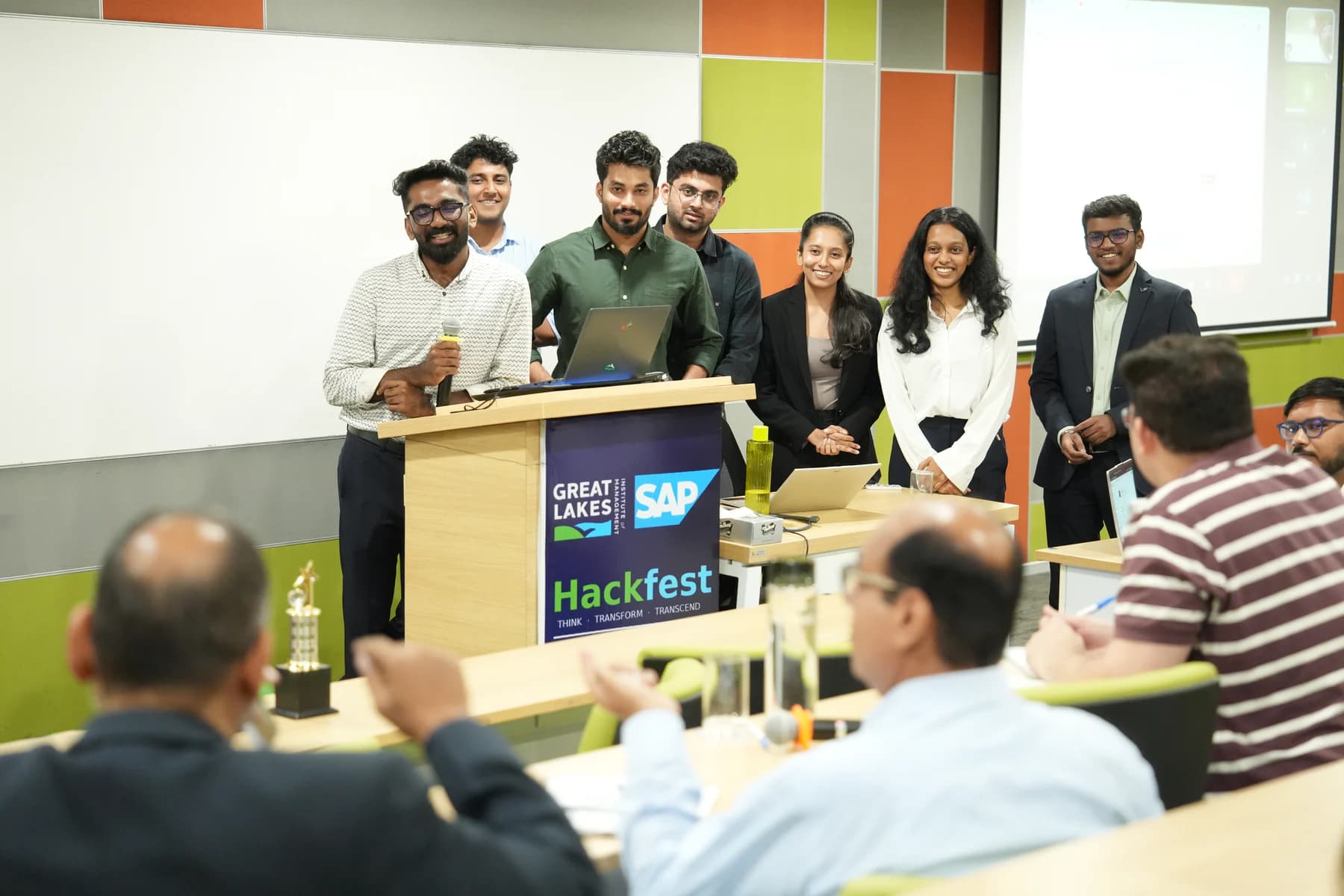
A student team presenting its work to a live audience and review panel

Learning in public

Teams turn analysis into a position they can defend.

The two-year journey creates room to revisit assumptions, integrate functional perspectives and communicate a recommendation before peers, faculty and external reviewers.

05 / Signature field lab

Primary evidence or it does not count.

Teams of up to six study a real company through a live founder, CXO or core-team interview. Websites and reports may provide context, but marks depend on the originality and depth of primary evidence.

25 marksNo email-only interviewsNo secondary-data-only projects
01

Select

Choose a startup or regular company, preferably under 10–15 years old.

02

Interview

Conduct a live, in-depth founder, CXO or core-team conversation.

03

Analyse

Apply course frameworks to original evidence, decisions and evolution.

04

Return

Email practical recommendations and request a 1–10 relevance rating.

Primary evidence

Audio/video or detailed interview notes and transcript

Strategic analysis

A focused 5–7 page report

Executive synthesis

A presentation of up to 10 slides

Individual meaning

A 150-word handwritten reflection from every member

Appendix 1 · Complete project guide

Report structure, interview protocol, email template and submission rules.

Open the field guide

06 / Interview question bank

A bank of 58 field-interview questions.

The interview bank spans resourcefulness, effectuation, dynamic capabilities, frugal innovation, entrepreneurial orientation, stakeholders and performance. Use it as a diagnostic menu—not a mechanical questionnaire.

Questions 01—07

Resource constraints & bricolage

+
  1. 01When you initiated your venture, what were the most significant resource constraints you encountered—limited funding, skills, technology or market access?
  2. 02Describe a situation where you had to creatively “make do” with only the resources immediately available. What did you repurpose and adapt?
  3. 03How have your personal experiences, professional background or specialized skills helped overcome a challenge or create an opportunity?
  4. 04How have social networks, relationships or community connections helped you access resources otherwise unavailable?
  5. 05Have you combined seemingly disparate assets, ideas or waste materials to develop a novel solution, product or service?
  6. 06How has your approach to acquiring and using resources evolved as the company grew or faced new environmental pressure?
  7. 07What role does improvisation play in your problem-solving culture when circumstances or resource limits are unexpected?

Questions 08—13

Effectuation & uncertainty

+
  1. 08Did you begin with a rigid long-term plan, or did your vision and goals evolve as you learned and adapted?
  2. 09How did you use the resources, skills and networks you already possessed to take the first concrete steps?
  3. 10Describe an unexpected challenge, setback or mistake. How did you respond, and did it create a new opportunity or pivot?
  4. 11When committing time, money or effort, did you focus on potential gain or on what you were prepared to lose?
  5. 12How have formal or informal collaborations changed the trajectory or resource base of the business?
  6. 13How do you manage uncertainty? Do your actions shape future opportunities, or are you more reactive to external forces?

Questions 14—19

Dynamic capabilities

+
  1. 14How does the company systematically identify emerging opportunities or threats such as technologies, customer shifts or competitor moves?
  2. 15Describe a successful response to a major market disruption or technological shift. Which internal routines enabled it?
  3. 16Once an opportunity is identified, how do you mobilize internal talent and knowledge plus external funding and partnerships?
  4. 17How do structure, routines and skills stay agile and aligned with the market? When did you last reconfigure operations or the business model?
  5. 18Which routines support continuous learning from market feedback, successful initiatives and failures?
  6. 19How do you balance exploitation of existing competencies and products with exploration of new opportunities?

Questions 20—31

Frugal innovation & jugaad

+
  1. 20Who are the primary target customers, and which unmet needs or problems does the product or service address?
  2. 21How did you lower cost relative to alternatives while still meeting customer expectations?
  3. 22Which features or complexities did you remove or simplify, and why were they non-essential?
  4. 23How did you ensure adequate performance for the intended purpose and local conditions despite cost reductions?
  5. 24How did resource constraints influence innovation, and did they unexpectedly produce more creative solutions?
  6. 25How does the innovation embody the principle of doing more with less?
  7. 26Describe an improvised or makeshift solution created because conventional resources or methods were unavailable.
  8. 27How did you transform a specific scarcity—capital, infrastructure or specialised labour—into an innovation opportunity?
  9. 28Was the primary motivation a cheaper alternative, an underserved segment or something else?
  10. 29How important were simplicity and affordability, and which design, production or delivery choices achieved them?
  11. 30How have local resources, unconventional methods or existing technologies been recombined to create customer value?
  12. 31How does the jugaad mindset—flexibility, resourcefulness and ingenuity—show up in culture and decisions?

Questions 32—43

Entrepreneurial orientation & creativity

+
  1. 32How does the company support novel ideas, experimentation and new products, services or processes?
  2. 33Describe an emerging opportunity the company pursued before the trend became obvious.
  3. 34How are the risks of new ventures managed? Describe a bold decision and the reasoning behind it.
  4. 35How does culture support or hinder innovation, proactiveness and risk-taking?
  5. 36How do you balance stability and efficiency with exploration and calculated risk?
  6. 37How does compensation or recognition encourage—or discourage—sensible risk and innovation?
  7. 38Describe a truly novel idea that significantly changed the business direction or offering.
  8. 39Which practices foster creative thinking when the problem is complex?
  9. 40How do you approach a problem with no obvious solution and connect seemingly unrelated concepts?
  10. 41How are novel ideas implemented and brought to market despite difficulties?
  11. 42How do personal background, experience or cognitive strengths help you see opportunities others miss?
  12. 43Describe a constraint that unexpectedly spurred a highly creative solution.

Questions 44—50

Stakeholder strategy

+
  1. 44Who are the most critical stakeholders, especially early on—customers, employees, investors, suppliers, community or government?
  2. 45How did you engage those stakeholders to secure funding, talent, partnerships or market access?
  3. 46Describe a time when stakeholder expectations conflicted. How did you navigate the tension?
  4. 47How do you build customer loyalty and advocacy beyond transactional interactions?
  5. 48How do you create transparency and trust with investors and employees during uncertainty or major change?
  6. 49How do mission and values account for the wider community or society?
  7. 50When has a strong stakeholder relationship created an unexpected benefit or opportunity?

Questions 51—58

Performance & current challenges

+
  1. 51How is success defined, and which financial and non-financial metrics are tracked?
  2. 52What have been the main drivers of revenue and profitability over the last one to three years?
  3. 53Which operational indicators—customer satisfaction, delivery, quality or efficiency—matter most, and how are they improved?
  4. 54How do you assess the growth trajectory, and which factors have been most important to sustained growth?
  5. 55What is difficult about measuring performance as a startup, regular company or SME, and how have you addressed it?
  6. 56How is performance communicated to investors, employees, customers and other stakeholders?
  7. 57How have innovation, proactiveness and stakeholder engagement directly affected firm performance?
  8. 58What current regulatory, growth or other strategic challenges is the company facing?

07 / Evidence of learning

Five signals. One hundred marks.

100total marks

Class descriptive & objective quizzes

Embedded questions·CO1 / PO1 · 10 | CO2 / PO2 · 10

20 marks

Reflection paper

Rubric·CO1 / PO1 · 2.5 | CO2 / PO2 · 2.5

5 marks

Midterm examination

Embedded questions·CO1 / PO1 · 10 | CO2 / PO2 · 5

15 marks

End-term examination

Embedded questions·CO1 / PO1 · 20 | CO2 / PO2 · 15

35 marks

Field analysis: startup or regular company

Rubric·CO1 / PO1 · 10 | CO2 / PO2 · 15

25 marks

Reflection rubric

Concepts and critical thinking carry equal weight.

50%

Concepts & frameworks

Understand and integrate tools for strategy formulation and execution.

50%

Critical thinking

Demonstrate analytical capability for strategic decision-making.

Field-project rubric

Original evidence, disciplined analysis.

40%

Framework application

Integrate strategy concepts, tools and frameworks with the company evidence.

60%

Strategic reasoning

Demonstrate conceptual, analytical and critical-thinking capability.

08 / Capability outcomes

Ten capabilities, from diagnosis to persuasion.

CO 1 builds command of formulation and execution frameworks. CO 2 develops conceptual, analytical and critical thinking for strategic decisions.

  1. 01

    Explain the characteristics of a well-conceived strategy and formulate one for competitive advantage.

  2. 02

    Manage the parts of a business in strategic harmony.

  3. 03

    Assess business risk and make sound decisions from collected and analysed data.

  4. 04

    Analyse industry structure and recommend a favourable competitive position.

  5. 05

    Diagnose, enhance and sustain a firm’s competitive advantage.

  6. 06

    Evaluate corporate strategy and recommend vertical and horizontal changes to firm boundaries.

  7. 07

    Evaluate global strategy and recommend ways to improve global performance.

  8. 08

    Complete a comprehensive company analysis with problems, solutions and an implementation timeline.

  9. 09

    Provide a thoughtful critique of others’ arguments, analyses and evidence.

  10. 10

    Communicate arguments coherently and persuasively.

PGDM programme outcomes

PO-1

Conceptual grounding in and application of business theory.

PO-2

Analytic and decision-making skills.

PO-3

Socio-cultural sensitisation and ethical awareness.

PO-4a

Managerial and leadership skills.

PO-4b

Team skills.

PO-5

Anticipate, strategise and adapt to global market changes.

PO-6

Effective oral and written communication and presentation techniques.

Connected practice

Move from AI opportunity to responsible adoption.

The build record and field note extend this course’s work on technology, evidence and implementation.

PGDM learning lab

AI Mini Hackathon

See how an incoming PGDM cohort turned student problems into testable GenAI prototypes.

Explore the programme

LinkedIn field note

Why do LLMs hallucinate?

A practical note on probabilistic generation, verification, and why fluent AI outputs still need human judgment.

Read on LinkedIn (opens in a new tab)

09 / References

Research behind the course design.

Inline citations connect the learning design to established work on strategy, the case method and assurance of learning.

  1. [1]Porter, M. E. (1996). What Is Strategy?. Harvard Business Review.
  2. [2]Harvard Business School (n.d.). The Case Method. Harvard Business School.
  3. [3]Porter, M. E. (2008). The Five Competitive Forces That Shape Strategy. Harvard Business Review.
  4. [4]Mintzberg, H. (1987). Crafting Strategy. Harvard Business Review.
  5. [5]Collis, D. J., & Montgomery, C. A. (1995). Competing on Resources. Harvard Business Review.
  6. [6]Mankins, M. C., & Steele, R. (2005). Turning Great Strategy into Great Performance. Harvard Business Review.
  7. [7]AACSB International (2022). 2020 Guiding Principles and Standards for Business Accreditation. AACSB International.
  8. [8]Rothaermel, F. T. (2024). Strategic Management, 6th edition. McGraw Hill.

Complete course reading list

Core textbook plus all 22 recommended books, cases and articles in the teaching plan.

+
  1. 01Rothaermel, F. T. Strategic Management (latest edition).
  2. 02Porter, M. E. (1980). Competitive Strategy: Techniques for Analyzing Industries and Competitors.
  3. 03Rumelt, R. P. (2011). Good Strategy/Bad Strategy.
  4. 04Collins, J. Good to Great.
  5. 05Christensen, C. M. The Innovator’s Dilemma.
  6. 06Collis, D. J., & Rukstad, M. G. (2008). Can You Say What Your Strategy Is?
  7. 07Campbell, A., Goold, M., & Alexander, M. (1995). Corporate Strategy: The Quest for Parenting Advantage.
  8. 08Case · Louis Vuitton Moët Hennessy: In Search of Synergies in the Global Luxury Industry.
  9. 09Deighton, J. How Snapple Got Its Juice Back.
  10. 10Case · Eli Lilly in India: Rethinking the Joint Venture Strategy.
  11. 11Case · Microsoft Acquires Activision Blizzard: Beating Sony in Gaming and the Metaverse.
  12. 12Mergers and Acquisitions: The New Rules of Attraction. The Economist.
  13. 13Barton, D. (2011). Capitalism for the Long Term.
  14. 14Case · Creating Corporate Advantage: The Case of the Tata Group.
  15. 15Burgelman, R. A., & Grove, A. Strategic Dissonance.
  16. 16Laeven, L., & Levine, R. (2006). Is There a Diversification Discount in Financial Conglomerates?
  17. 17Case · Amazon Go: Venturing into Traditional Retail.
  18. 18Porter, M. E. The Competitive Advantage of Nations.
  19. 19Dewhurst, M., Harris, J., & Heywood, S. Understanding Your Globalization Penalty.
  20. 20Case · Coca-Cola in 2011: In Search of a New Model.
  21. 21Buzzell, R. D. Is Vertical Integration Profitable?
  22. 22Mankins, M. C., & Steele, R. Turning Great Strategy into Great Performance.
  23. 23Hamel, G. Moon Shots for Management?

Looking for the accelerated executive-format course?

Explore the 1-Year MBA